 WhatIs.site
Table of Contents
What Is Agile Software Development?
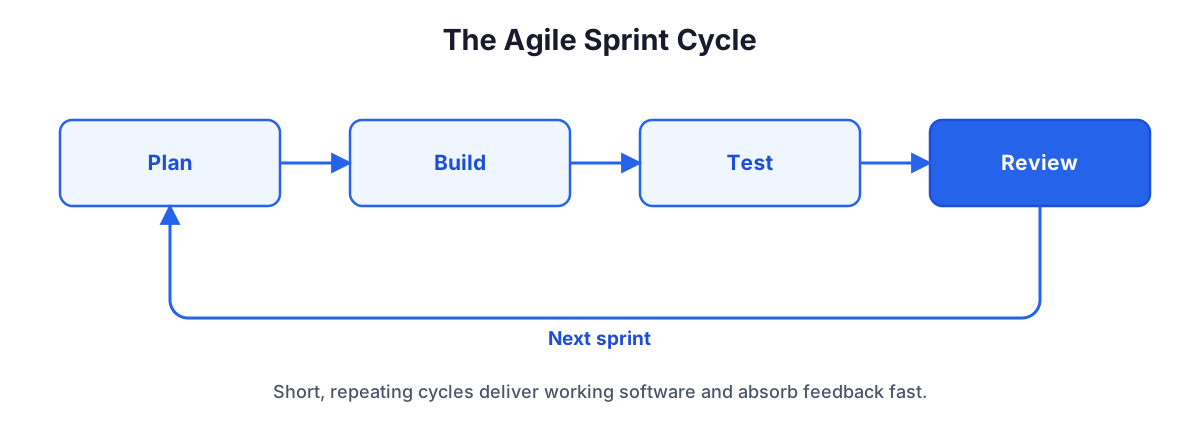
Agile software development is a set of principles and practices for building software through short, repeated cycles of planning, building, testing, and gathering feedback. Instead of trying to design everything upfront and delivering one massive release, Agile teams ship small pieces of working software frequently — usually every one to four weeks — and adjust direction based on what they learn.
The Problem Agile Was Built to Solve
To understand why Agile exists, you need to understand what came before it. And frankly, what came before it was a mess.
Through the 1980s and 1990s, most software teams followed what’s now called the Waterfall model. The process was linear: gather all requirements, design the entire system, build it, test it, deploy it. Each phase had to finish before the next could start. On paper, this made perfect sense. In practice, it was a disaster.
Here’s why. Software projects typically took 12 to 24 months from start to delivery. By the time a team shipped the finished product, the business requirements had changed. Users wanted something different from what they’d asked for a year earlier. Competitors had moved. Markets had shifted. The Standish Group’s famous CHAOS Report from 1994 found that only 16% of software projects were completed on time and on budget. A staggering 31% were cancelled outright. The remaining 53% went over budget, over schedule, or delivered fewer features than planned.
The core issue wasn’t that developers were bad at their jobs. The issue was that nobody — not the customers, not the managers, not the developers — could accurately predict what a complex software system should look like 18 months into the future. Requirements changed, and Waterfall had no mechanism to handle change gracefully. Any modification meant restarting expensive phases of work.
By the late 1990s, several groups of practitioners were independently experimenting with lighter, more iterative approaches. Kent Beck was developing Extreme Programming (XP). Jeff Sutherland and Ken Schwaber were formalizing Scrum. Alistair Cockburn was working on Crystal. Jim Highsmith promoted Adaptive Software Development. These approaches shared a common DNA: work in short cycles, get feedback early, and adapt.
The Manifesto That Changed Everything
In February 2001, seventeen software developers met at a ski lodge in Snowbird, Utah. They represented different methodologies and sometimes disagreed on specifics. But they found enough common ground to produce a 68-word document that reshaped the entire software industry.
The Agile Manifesto declared four core values:
Individuals and interactions over processes and tools. Working software over documentation. Customer collaboration over contract negotiation. Responding to change over following a plan.
The manifesto’s careful phrasing matters. It doesn’t say processes, documentation, contracts, and plans are worthless. It says the items on the left matter more. This distinction gets lost constantly — people either dismiss Agile as “no planning” or implement it as rigid process theater. Both miss the point entirely.
Alongside the four values, the signatories outlined twelve principles. A few that still resonate:
- Deliver working software frequently, from a couple of weeks to a couple of months, with a preference for shorter timescales.
- Welcome changing requirements, even late in development.
- Business people and developers must work together daily throughout the project.
- Build projects around motivated individuals. Give them the environment and support they need, and trust them to get the job done.
- The best architectures, requirements, and designs emerge from self-organizing teams.
These weren’t abstract ideas. They were hard-won lessons from people who’d watched years of projects fail under rigid, plan-heavy methodologies.
Scrum: The Most Popular Agile Framework
If Agile is the philosophy, Scrum is the most widely adopted playbook. According to Digital.ai’s State of Agile surveys, roughly 66% of Agile teams use Scrum or a Scrum-based hybrid. It was formalized by Jeff Sutherland and Ken Schwaber in the early 1990s and continues to be governed by the official Scrum Guide.
The Roles
Scrum defines three roles:
Product Owner — This person represents the customer and the business. They maintain a prioritized backlog of features and user stories, deciding what gets built next. A good Product Owner makes hard trade-off decisions and ensures the team builds the most valuable thing first. A bad one either micromanages or disappears entirely.
Scrum Master — Part coach, part obstacle-remover, part process guardian. The Scrum Master doesn’t manage the team — they serve the team. They facilitate meetings, protect the team from outside interruptions, and help the team improve its own processes. Think of them as a combination of referee and therapist.
Development Team — The people who actually build the product. Scrum teams are typically 3 to 9 people and are cross-functional, meaning the team collectively has all the skills needed to deliver working software. No handoffs to other departments. No waiting for approvals from distant specialists.
The Sprint Cycle
Scrum organizes work into fixed-length iterations called sprints, usually lasting two weeks. Each sprint follows a predictable rhythm:
Sprint Planning — The team selects items from the product backlog to work on during the sprint. They break these into smaller tasks and commit to what they believe they can finish. This meeting typically lasts two to four hours for a two-week sprint.
Daily Standup (or Daily Scrum) — A 15-minute meeting, every day, where each team member answers three questions: What did I do yesterday? What will I do today? What’s blocking me? The standup isn’t a status report for managers. It’s a coordination mechanism for the team.
Sprint Review — At the end of the sprint, the team demonstrates the working software they’ve built to stakeholders. Real software, actually running — not slides, not mockups. Stakeholders provide feedback that shapes future work.
Sprint Retrospective — The team reflects on how they worked during the sprint. What went well? What didn’t? What should they change? This is arguably the most important ceremony in Scrum because it creates a built-in improvement mechanism. Teams that skip retros stop getting better.
Artifacts
Product Backlog — An ordered list of everything that might need to be built. User stories, bugs, technical improvements, experiments. The Product Owner owns this list and continuously refines it.
Sprint Backlog — The subset of backlog items the team has committed to for the current sprint, plus their plan for delivering them.
Increment — The working, potentially shippable product at the end of each sprint. Each increment adds to everything built in previous sprints. The key word is “working” — incomplete features don’t count.
Kanban: The Flow-Based Alternative
Not every team loves sprints. Some find the fixed-length iteration artificial, especially teams doing maintenance work, handling support tickets, or managing work that arrives unpredictably. For them, Kanban offers a different Agile approach.
Kanban originated in Toyota’s manufacturing system in the 1940s — the Japanese word literally means “signboard” or “visual card.” David J. Anderson adapted it for software engineering work in the mid-2000s.
Core Practices
Visualize the workflow. Every piece of work gets represented as a card on a board. Columns represent stages: To Do, In Progress, Code Review, Testing, Done. At a glance, anyone can see what’s being worked on, what’s stuck, and where bottlenecks are forming.
Limit work in progress (WIP). This is Kanban’s secret weapon. Each column gets a maximum number of items that can be in it simultaneously. If the Testing column has a WIP limit of 3 and there are already 3 items there, nobody can push new work into Testing until something moves to Done. This sounds simple. It’s actually profound — it forces teams to finish work before starting new work, which dramatically reduces the time items spend sitting in queues.
Manage flow. Instead of measuring velocity (how much the team completes per sprint), Kanban teams measure lead time (how long an item takes from request to delivery) and cycle time (how long an item takes once work begins). The goal is smooth, predictable flow — not heroic bursts of effort.
Make process policies explicit. What does “Done” actually mean? What criteria must code pass before moving from Review to Testing? Kanban insists teams write down these rules so everyone operates with the same understanding.
Improve collaboratively. Like Scrum’s retrospective, Kanban encourages continuous improvement — but without the fixed sprint cadence. Teams review their flow metrics and experiment with changes whenever they identify problems.
When to Choose Kanban Over Scrum
Kanban works particularly well for teams handling a continuous stream of incoming requests — IT support teams, DevOps groups, maintenance crews. It also suits teams that resist the overhead of sprint ceremonies or where work items vary wildly in size and predictability. Many teams end up using a hybrid sometimes called “Scrumban” — sprint structure from Scrum with WIP limits and flow metrics from Kanban.
Beyond Scrum and Kanban: Other Agile Frameworks
Scrum and Kanban get most of the attention, but the Agile ecosystem includes other approaches worth knowing about.
Extreme Programming (XP) — Created by Kent Beck, XP emphasizes engineering practices as much as process. Pair programming, test-driven development (TDD), continuous integration, collective code ownership, and frequent releases are all core XP practices. Many of these have been absorbed into mainstream development even by teams that don’t formally follow XP.
Lean Software Development — Adapted from lean manufacturing principles at Toyota, Lean focuses on eliminating waste, delivering fast, and amplifying learning. It asks teams to identify which activities create value for the customer and cut everything else. Lean thinking heavily influenced Kanban.
SAFe (Scaled Agile Framework) — When organizations with hundreds of developers try to use Agile, they need coordination mechanisms beyond a single Scrum team. SAFe provides structure for scaling Agile across large enterprises. It’s popular with big companies and unpopular with many Agile purists who see it as reintroducing the bureaucracy Agile was supposed to eliminate. Whether SAFe represents Agile scaling or Agile co-option depends on who you ask.
LeSS (Large-Scale Scrum) and Nexus offer lighter-weight alternatives to SAFe for scaling Scrum across multiple teams.
What Agile Looks Like in Practice
Theory is nice. Let’s talk about what actually happens when a team goes Agile.
Picture a team of seven developers building a mobile banking app. Their Product Owner has a backlog of 200+ items, ranging from “user can check account balance” to “app supports biometric login.” She has ranked them by business value and customer demand.
The team starts a two-week sprint by pulling the top items from the backlog. They estimate the work using story points — a relative sizing system where a “1-point” story is trivially simple and an “8-point” story is complex. Based on their history, they know they can complete about 30 story points per sprint. They pull items totaling roughly that amount.
For the next two weeks, the team writes code, writes tests, reviews each other’s work, and deploys to a staging environment. They meet for 15 minutes every morning to coordinate. When a developer finishes a feature, it goes through code review and automated testing before being merged. The Product Owner is available throughout the sprint to clarify requirements and answer questions.
At the sprint review, the team demonstrates a working version of the app with three new features. Stakeholders from marketing notice that the account balance screen doesn’t show pending transactions — something nobody thought of during planning. The Product Owner adds “show pending transactions” to the backlog and prioritizes it for the next sprint.
At the retrospective, the team notes that code reviews took too long this sprint. They agree to a new policy: reviews must be completed within 4 hours of submission. They’ll check whether this helped at the next retro.
This cycle repeats every two weeks. The app grows incrementally. Mistakes get caught early. Priorities shift based on real feedback. Nobody spends six months building features nobody wants.
Why Agile Works (When It Works)
Agile’s effectiveness isn’t magic — it comes from some genuinely sound principles that align with how humans actually work and learn.
Shorter feedback loops catch problems early. Finding a design mistake in week 2 costs a fraction of finding it in month 14. Every sprint review is an opportunity to course-correct before too much time and money are wasted.
Working software beats speculation. Until users touch real software, nobody truly knows what they want. Agile gets working software in front of users quickly, which generates far more useful feedback than requirements documents or wireframes. People react to concrete things.
Small batches reduce risk. Shipping a feature every two weeks means any individual release carries minimal risk. If something breaks, the change set is small enough to diagnose quickly. Compare this to a massive release where thousands of changes go live simultaneously and nobody knows which one caused the bug.
Teams improve continuously. The retrospective creates a structural mechanism for getting better. Teams that run honest retros every two weeks are running 26 improvement experiments per year. Over time, this compounds dramatically.
Motivated teams produce better work. Agile’s emphasis on trust, autonomy, and self-organization tends to create more engaged teams. People who have a say in how they work generally care more about their work. This isn’t idealism — it’s backed by decades of research in organizational psychology, including findings around cognitive bias in decision-making that affect how teams plan and estimate.
Why Agile Fails (When It Fails)
Here’s what most people miss: Agile fails at least as often as it succeeds. But the failures almost always stem from the same root causes.
“Agile in name only.” Organizations adopt Agile terminology — sprints, standups, backlogs — without the underlying values. They run daily standups that are actually status reports to management. They assign work to individuals instead of letting teams self-organize. They skip retrospectives because they’re “too busy.” This is sometimes called “Cargo Cult Agile” and it’s painfully common.
No empowered Product Owner. If the person deciding what to build can’t actually make decisions — if every choice needs committee approval — the whole system breaks down. The team builds the wrong things, priorities shift mid-sprint, and the backlog becomes a political battlefield.
Ignoring technical practices. Agile without good engineering practices is sprinting toward a cliff. Without automated testing, continuous integration, refactoring, and clean code practices, technical debt accumulates sprint after sprint until the team can barely move. XP had this right from the start — process alone isn’t enough.
Management that won’t let go. Agile asks managers to trust teams. Some managers find this terrifying. They respond by adding more oversight, more reporting, more control — which directly undermines the self-organization that makes Agile work.
Scaling too fast. A single Scrum team of seven people is manageable. Fifty Scrum teams trying to build one product is an organizational design problem that no framework fully solves. Coordination overhead grows quadratically with team count.
The Agile-Adjacent Practices That Matter
Agile doesn’t exist in isolation. Several technical and cultural practices have grown alongside it:
Continuous Integration / Continuous Deployment (CI/CD) — Developers merge code into the main branch frequently (often multiple times per day), and automated pipelines build, test, and deploy that code. CI/CD makes Agile’s frequent delivery promise technically possible.
DevOps — The cultural and technical movement to break down walls between development and operations teams. If your developers can write code quickly but deployments take three months of paperwork, Agile can’t deliver on its promises. DevOps ensures the full pipeline from code to production is fast and reliable.
Test-Driven Development (TDD) — Write the test before writing the code. This practice, borrowed from XP, ensures every feature has automated tests and helps developers think about design before implementation.
User Story Mapping — A technique for organizing backlog items into a visual map that shows the user’s journey through the product. It helps teams see the big picture while still working in small increments.
Pair Programming and Mob Programming — Two developers at one computer (pair) or the whole team at one computer (mob). These practices spread knowledge, catch bugs instantly, and improve code quality. They feel inefficient but research consistently shows they reduce total development time by catching problems earlier.
Agile by the Numbers
The data paints a clear picture of Agile’s impact on the industry:
- The 15th State of Agile Report found that 94% of organizations practice Agile in some form.
- Teams using Agile report a 60% improvement in their ability to manage changing priorities — the single biggest benefit cited by respondents.
- Scrum remains the most popular framework at around 66% adoption, followed by Scrum/XP hybrids and Kanban.
- The average Agile team size is 7 people, aligning with Scrum’s recommended range of 3-9.
- Organizations report 30-40% faster time-to-market after adopting Agile practices.
- However, only 10% of organizations report that all their teams are Agile. Most have a mix of Agile and traditional approaches.
These numbers come with caveats. “Practicing Agile” can mean wildly different things across organizations. A team running real Scrum with empowered teams and continuous delivery operates in a completely different universe from a team that renamed its weekly status meeting to “standup” and called it Agile.
Agile and Machine Learning
An interesting challenge has emerged as more teams build artificial intelligence and machine learning products. Traditional Agile assumes you can define a user story, build it, and demo working results in a sprint. But ML work often involves experiments that might not produce useful results for weeks. Training a model isn’t like writing a feature — you might try ten approaches before one works, and “done” is a matter of accuracy thresholds, not feature completion.
Teams adapting Agile for ML work often modify the sprint structure to accommodate research spikes, use different definitions of “done” for experimental vs. production work, and pair data scientists with software engineers to bridge the gap between research and deployable code.
The Evolution of Agile: 2001 to Today
Agile has changed significantly since those seventeen developers met in Utah.
2001-2005: The Early Adopters. Small, forward-thinking teams embraced Scrum and XP. Larger organizations mostly ignored Agile or dismissed it as undisciplined.
2006-2010: The Tipping Point. Agile went mainstream. Certified ScrumMaster training became a cottage industry. Companies like Spotify developed their own Agile models (the “Spotify Model” of squads, tribes, chapters, and guilds became widely imitated — often poorly).
2011-2015: Enterprise Adoption. Large organizations adopted Agile en masse, driving demand for scaling frameworks like SAFe. This period also saw significant “Agile industrial complex” criticism — consultancies selling expensive certifications and transformations that sometimes delivered more process than improvement.
2016-2020: The DevOps Convergence. Agile merged with DevOps thinking. Teams realized that fast development without fast deployment was pointless. Cloud computing made infrastructure flexible enough to support continuous delivery. The cultural component of Agile — trust, autonomy, psychological safety — received more attention.
2021-Present: Maturity and Reflection. The Agile community has become more self-critical. The original manifesto authors have mixed feelings about what Agile became. Some, like Dave Thomas, have argued that “Agile” the noun (the industry of certifications, frameworks, and consultancies) has corrupted “agile” the adjective (the actual quality of being nimble and adaptive). There’s a growing movement back toward simplicity — fewer ceremonies, less framework overhead, more focus on actual engineering excellence and team empowerment.
Is Agile Right for Your Team?
Agile isn’t a universal solution. Here’s an honest assessment of where it shines and where it doesn’t.
Agile works well when:
- Requirements are uncertain or likely to change
- Customer feedback is available and valuable
- The team is co-located or has strong remote collaboration tools
- Management genuinely supports team autonomy
- The product can be delivered incrementally
- The domain is complex enough that upfront planning can’t anticipate everything
Agile struggles when:
- Requirements are fixed and well-understood (building to a spec)
- Regulatory compliance demands extensive upfront documentation
- The team lacks the engineering practices to deliver safely at speed
- Organizational culture resists transparency and shared ownership
- Stakeholders are unavailable for regular feedback
- The project has hard deadlines with fixed scope (Agile prefers flexible scope)
The honest truth is that most software teams today should default to some form of Agile — the feedback loops and adaptability are simply too valuable to ignore. But “some form” is doing a lot of heavy lifting in that sentence. A two-person startup using Kanban on a whiteboard and a 500-person bank running SAFe across 60 teams are both “doing Agile.” Their experiences share almost nothing in common.
Getting Started with Agile
If you’re convinced Agile might help your team, here’s a practical starting point.
Start with Scrum if your team builds products with a clear backlog of features. Start with Kanban if your team handles incoming requests or maintenance work. Either way, the first step is the same: make your work visible. Put every task on a board where everyone can see it. This single act reveals bottlenecks, hidden work, and overloaded team members more effectively than any reporting tool.
Then pick one practice and do it well. Daily standups are a great starting point — 15 minutes, same time every day, three questions. Get comfortable with that rhythm before adding sprint planning, reviews, and retros. Don’t try to implement everything at once. That would be, well, very un-Agile.
Key Takeaways
Agile software development replaced the rigid, plan-everything-upfront approach with short cycles of building, testing, and learning. Born from a 2001 meeting of seventeen practitioners, it’s grown to become the dominant approach in software — with 94% of organizations practicing some form of it. Scrum and Kanban are the two most popular implementations, each suited to different work patterns. The approach works because shorter feedback loops catch problems earlier, working software generates better feedback than documents, and self-organizing teams produce better outcomes. But Agile fails when organizations adopt the terminology without the values — when standups become status reports, when retrospectives get skipped, and when management won’t actually trust their teams.
The best advice for anyone approaching Agile? Focus less on following a framework perfectly and more on the underlying principle: build something small, show it to someone, learn from their reaction, and repeat. Everything else is details.
Frequently Asked Questions
What is the difference between Agile and Scrum?
Agile is a broad philosophy and set of values for building software through iteration and collaboration. Scrum is one specific framework that implements Agile principles using defined roles (Scrum Master, Product Owner, Development Team), fixed-length sprints (usually 2 weeks), and ceremonies like daily standups and sprint reviews. You can be Agile without using Scrum.
Can Agile work for non-software projects?
Yes. Agile principles have been successfully applied to marketing campaigns, product design, HR processes, construction planning, and even education. Any project that benefits from iterative progress, frequent feedback, and flexibility can use Agile thinking. Frameworks like Kanban are especially popular outside software.
How long is a typical Agile sprint?
Most teams run sprints of 1 to 4 weeks, with 2 weeks being the most common choice. Shorter sprints give faster feedback but increase meeting overhead. Longer sprints allow deeper work but delay course corrections. Teams usually experiment to find their ideal cadence.
What are the four values of the Agile Manifesto?
The Agile Manifesto values individuals and interactions over processes and tools, working software over documentation, customer collaboration over contract negotiation, and responding to change over following a plan. The manifesto clarifies that while the items on the right have value, the items on the left are valued more.
Is Waterfall dead because of Agile?
Not entirely. Waterfall still works well for projects with fixed, well-understood requirements where changes are unlikely or expensive, like building bridges or manufacturing hardware. But for software, where requirements shift constantly and user feedback matters, Agile has largely replaced Waterfall as the default approach.
Further Reading
Cite this article
APA
WhatIs.site. (2026). What Is Agile Software Development?. Retrieved May 27, 2026, from https://whatis.site/agile-software-development MLA
"What Is Agile Software Development?." WhatIs.site, March 6, 2026, https://whatis.site/agile-software-development. Accessed May 27, 2026. Chicago
WhatIs.site. "What Is Agile Software Development?." Last modified May 12, 2026. https://whatis.site/agile-software-development. HTML
<a href="https://whatis.site/agile-software-development">What Is Agile Software Development?</a> — WhatIs.site Related Articles
What Is Machine Learning? How Computers Learn Without Being Programmed
Machine learning enables computers to learn patterns from data and make decisions without explicit programming. Explore how it works and why it matters.
technologyWhat Is Blockchain?
Blockchain is a distributed digital ledger that records transactions across many computers in a way that makes it nearly impossible to alter past records.
technologyWhat Is Cloud Computing?
Cloud computing delivers computing resources over the internet on demand. Learn about IaaS, PaaS, SaaS, major providers, and how the cloud actually works.
technologyWhat Is Project Management?
Project management is how teams plan, execute, and deliver work on time and on budget. Learn the methods, tools, and skills that make projects succeed.
technologyWhat Is Software Engineering?
Software engineering is the disciplined approach to designing, building, testing, and maintaining software systems. Learn its principles, methods, and history.