 WhatIs.site
Table of Contents
What Is Machine Learning? How Computers Learn Without Being Programmed
Machine learning is a branch of artificial intelligence that teaches computers to learn patterns from data and make predictions without being explicitly programmed for every scenario. Rather than following step-by-step instructions you write out, a machine learning system examines examples, identifies patterns, and then applies what it learned to new, unseen data.
The fundamental idea is deceptively simple: show a computer lots of examples, let it figure out the underlying rules, and trust it to apply those rules to situations it’s never encountered before.
For current AI adoption statistics — including the 71% of organizations using generative AI in at least one function — see our AI Statistics 2026 roundup.
Why Machine Learning Matters Right Now
We’re drowning in data. Every click you make online, every photo you take, every transaction you complete generates more of it. That’s a trillion-data-points-per-day kind of abundance. Traditional programming can’t scale to handle that. You can’t write code to handle every possible permutation.
Machine learning solves this problem by flipping the script. Instead of humans writing the rules, we let the computer discover the rules. Your email spam filter? Machine learning. Your smartphone’s face recognition? Machine learning. Netflix recommendations? YouTube suggestions? Your bank detecting fraud? All machine learning.
The weird part is that these systems often improve themselves. The more data they see, the better they get. They don’t need you to manually update them. That’s the appeal—and it’s precisely why machine learning has become so central to modern computing.
The Basic Mechanics: How Learning Actually Happens
Machine learning works fundamentally through iteration and feedback. Here’s the process:
Step one: You collect data. This might be thousands (or millions) of photos labeled with what’s in them. Customer transactions labeled as “fraud” or “legitimate.” Emails labeled as “spam” or “not spam.” The labels are crucial—they’re the answer key the system learns from.
Step two: You choose a model architecture. A model is essentially a mathematical structure with adjustable parameters. Think of it like a recipe where the ingredients are fixed but the amounts are variable. Different model types work better for different problems—decision trees for some tasks, neural networks for others, linear regression for straightforward relationships.
Step three: You feed data through the model. The model makes predictions based on its current (usually random) parameters. Those predictions will be terrible at first. A randomly initialized neural network asked to recognize cats will be spectacularly wrong.
Step four: You measure how wrong the model was. This measurement is called the “loss” or “error.” It quantifies the gap between what the model predicted and what actually happened. This is where the learning happens—not in the predictions themselves, but in understanding how wrong you were.
Step five: You adjust the parameters to reduce that error. Using mathematics (usually calculus-based optimization), you nudge the model’s parameters in directions that make future predictions closer to correct. Then you repeat. Step three through five happen thousands or millions of times.
Step six: You validate on data the model never saw. This is critical. If you only tested on the data the model learned from, you’d have no idea if it actually learned the underlying pattern or just memorized the answers (a problem called “overfitting”).
This cycle—predict, measure error, adjust, repeat—is the heartbeat of machine learning.
Different Types of Learning
Not all machine learning works the same way. The main categories reflect different assumptions about what you’re trying to accomplish.
Supervised learning is what most people imagine when they think of machine learning. You have labeled data (inputs paired with correct outputs), and you’re trying to learn the relationship between them. Predict house prices based on features like square footage and location. Classify emails as spam or not spam. Predict whether a patient has a disease based on medical tests. The label—the correct answer—supervises the learning process. This is why it’s called “supervised.” Classification and regression are the two major flavors of supervised learning tasks.
Unsupervised learning has no labels. You just have data, and you’re looking for hidden patterns or structure within it. Maybe you have customer purchase histories, and you want to discover natural groupings—customer segments that share similar buying behaviors. You’re not predicting a specific outcome; you’re exploring. Clustering algorithms group similar items together. Dimensionality reduction techniques simplify high-dimensional data while preserving important patterns.
Reinforcement learning mimics how humans and animals learn through trial and error, with rewards and penalties. An AI playing chess or Go doesn’t learn from labeled game outcomes; it learns by playing thousands of games, receiving a reward signal when it wins. AlphaGo, the system that defeated world champions at Go, learned primarily through reinforcement learning—playing against itself millions of times and getting better through feedback.
There’s also a middle ground. Semi-supervised learning works with mostly unlabeled data plus a small amount of labeled data. Self-supervised learning creates its own labels from the data itself—like teaching a system to predict the next word in a sentence using all the previous words as context.
The Models: Decision Trees Through Neural Networks
The term “model” gets used loosely, but it refers to the specific mathematical structure you’re using. Different problems benefit from different architectures.
Decision trees work exactly as they sound—they’re trees of yes/no questions. “Is age greater than 18?” → “Is income greater than $50k?” → and so on. Each path through the tree leads to a prediction. They’re interpretable (you can see why they made a decision) and handle non-linear relationships, though they can overfit easily.
Linear and logistic regression are simpler approaches where you’re fitting a line (or curve) to your data. Linear regression predicts continuous values; logistic regression handles yes/no classification. They’re fast, efficient, and often give solid baselines for performance.
Support Vector Machines (SVMs) find the optimal way to separate different classes of data. Imagine trying to draw a line that separates cats from dogs in a plot—an SVM finds the best possible line (or, in higher dimensions, the best hyperplane). They work well for clear separations but can be slower to train on large datasets.
Random forests build multiple decision trees and combine their predictions, usually through averaging or voting. This ensemble approach typically outperforms single trees while reducing overfitting.
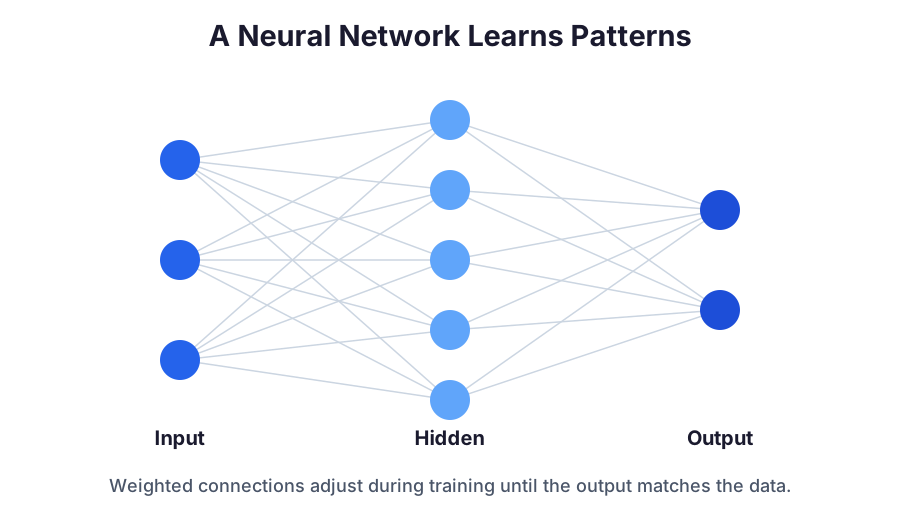
Neural networks, especially deep learning architectures, are inspired by how brains process information. They’re networks of interconnected nodes (neurons) arranged in layers. Data flows in one side, gets transformed by each layer, and produces an output. Deep networks have many layers, enabling them to learn incredibly complex, non-linear patterns. Convolutional neural networks (CNNs) excel at image recognition. Recurrent neural networks (RNNs) handle sequential data like text and time series. Transformers, the architecture behind modern language models, process entire sequences in parallel rather than step-by-step.
The choice of model depends on your specific problem—the size of your data, the nature of the relationships you’re trying to capture, how much interpretability you need, and your computational resources.
Training, Validation, Testing: The Holy Trinity
This might sound like three separate steps, but they’re actually the scaffolding that determines whether your model actually works or just appears to work.
During training, the model sees your labeled data and adjusts its parameters. This is where learning happens. But here’s the trap: if you test the model’s performance on the same data it trained on, it’ll look much better than it actually is. A model can memorize specific examples without learning generalizable patterns. That’s overfitting, and it’s the subtle monster lurking in most machine learning projects.
That’s why you hold out validation data—typically 10-20% of your data that the model never sees during training. You evaluate performance on this data to detect overfitting. If training accuracy is 95% but validation accuracy is 65%, something’s wrong. You might adjust your model architecture, try regularization (penalties that discourage the model from becoming too complex), or collect more data.
Finally, you keep completely separate test data, maybe another 10-20% of your original data. This is your final check—the data you look at only once, at the very end, to get an honest assessment of how the model performs on completely new information. This number matters. This is what you’ll tell people.
The split between training, validation, and test data is one of the most important decisions in machine learning, and it’s also frequently done wrong. If you have limited data, you might use techniques like k-fold cross-validation, where you split data into k chunks, train on k-1 of them and test on 1, then repeat—averaging the results across all folds.
The Data Question: Quality Over Quantity
Here’s something that surprises people: more data isn’t always better. Bad data at scale is just catastrophically bad data.
Consider a real example. Researchers building a facial recognition system tested it on a diverse group of people and found it misidentified dark-skinned women far more often than light-skinned men. Why? The training data had way more light-skinned faces. The model became excellent at recognizing light skin and mediocre at recognizing dark skin, simply because of what it learned from. The data had bias baked into it.
This illustrates a critical truth: machine learning systems are not neutral. They learn from data generated by humans making choices—what to photograph, what to label, what to include or exclude. Those choices embed biases into the model.
Quality data means:
- Representative: Does your data represent the diversity of real-world scenarios?
- Accurate: Are the labels correct? Noisy labels corrupt learning.
- Sufficient: Do you have enough examples for the pattern you’re trying to learn?
- Clean: Have you removed duplicates, fixed errors, handled missing values?
- Balanced: In classification problems, do you have roughly equal examples of each class?
Collecting and preparing data typically consumes 60-80% of a machine learning project’s time. It’s not glamorous, but it’s where the real work happens.
The Limits and Quirks
Machine learning isn’t magic, and it’s crucial to understand where it falls short.
Data dependency: Machine learning is only as smart as its training data. Feed it garbage, get garbage predictions.
Black box problem: Deep neural networks especially are notoriously hard to interpret. You can ask why a random forest made a particular decision (which features mattered most), but with a deep network? Good luck. The math is there, but human intuition fails. This matters in high-stakes domains like medicine or criminal justice, where you need to explain decisions.
Catastrophic forgetting: If you train a model on task A, then retrain it on task B, it often forgets task A. Humans learn continuously; most machine learning systems don’t.
Adversarial vulnerability: Small, carefully crafted changes to input data can fool machine learning systems in surprising ways. Add a barely-visible pattern to an image, and a neural network might misidentify it completely, while humans still see it correctly.
Correlation vs. causation: Machine learning excels at finding correlations in data. But correlation isn’t causation. A model might learn that “wearing a hospital gown” predicts death without understanding that people wear hospital gowns because they’re already dying.
Changing real-world conditions: Models trained on historical data assume that future data follows the same distribution. But the world changes. Trends shift. A model trained on pre-pandemic data might fail spectacularly when applied to pandemic conditions.
Real-World Applications That Actually Matter
The abstract becomes concrete when you see what machine learning does in practice:
Healthcare: Predicting disease progression, analyzing medical images to detect tumors, discovering drug candidates, personalizing treatment recommendations. Hospitals now use ML systems to predict patient deterioration hours before critical events.
Finance: Fraud detection, algorithmic trading, credit risk assessment, customer churn prediction. Banks process trillions in transactions partly because machine learning can flag suspicious patterns at machine speed.
Transportation: Autonomous vehicles rely on computer vision and reinforcement learning. Route optimization for delivery systems. Rideshare companies predict demand and position drivers using ML models trained on years of movement patterns.
Natural language processing: Chatbots, translation, sentiment analysis, autocomplete. Language models like GPT are built on machine learning foundations that enable them to generate human-like text.
Recommendation systems: Spotify suggesting songs, Amazon suggesting products, Netflix suggesting shows—all driven by machine learning algorithms learning your preferences. These systems account for a significant portion of many companies’ revenue.
Manufacturing: Predictive maintenance catches equipment failures before they happen, saving millions in downtime. Quality control through image recognition. Factories optimize production schedules based on ML models predicting demand and supply chain constraints.
Agriculture: Crop yield prediction, pest detection, precision irrigation based on soil and weather data. Farmers increasingly use ML to optimize fertilizer use and predict optimal harvest timing.
These aren’t hypothetical. They’re generating real value right now, in industries from healthcare to retail to agriculture.
How You Can Get Started
If you’re thinking about learning machine learning practically, here’s what a real path looks like:
Learn Python first if you haven’t. It’s the de facto language for machine learning. You don’t need to be a software engineer—but you do need enough Python fluency to read and modify code.
Pick up the fundamentals of data science—data cleaning, exploration, visualization, basic statistics. This is less glamorous than neural networks, but it’s where you’ll spend most of your time. Learning pandas and matplotlib will serve you better initially than learning advanced deep learning.
Start with scikit-learn, a Python library that makes traditional machine learning accessible. Build decision trees, random forests, SVMs. Get comfortable with the whole pipeline—loading data, splitting it, training models, evaluating them.
Progress to TensorFlow or PyTorch if you want to work with neural networks. Both have excellent documentation and tutorials. But honestly, you probably don’t need this yet. Most real-world problems solve just fine with traditional ML.
Practice on real datasets. Kaggle hosts competitions and datasets. Start with structured data before tackling images or text. Build models, submit predictions, see how you rank. You learn more from failing than from any tutorial.
Read papers. Andrew Ng’s machine learning course (available free on Coursera) is still one of the best introductions. After you have basics, papers from arXiv let you see the cutting edge.
Build actual projects. The theory matters, but understanding comes from hands-on experimentation. Pick a problem that interests you—predicting something about your hobbies, analyzing data from your industry, whatever keeps you engaged. Real curiosity beats forced tutorials every time.
The field is moving fast, which means learning is never finished. New architectures, new techniques, new applications appear constantly. But the fundamentals—the idea that systems can learn from data—remain solid.
Feature Engineering: The Secret Ingredient
Here’s something they don’t always emphasize in machine learning courses: the quality of your features matters as much as the quality of your algorithm. This process is called feature engineering, and it’s where domain expertise becomes critical.
A feature is just an input variable—an attribute of your data that you’re feeding into your model. But choosing which features to include, how to transform them, and how to combine them? That’s an art form.
Consider building a model to predict house prices. Raw features might be: square footage, number of bedrooms, age of the house. But what if you create a new feature—price per square foot? Or what if you notice that houses near excellent schools sell for more, so you add a feature capturing proximity to top-rated schools? These engineered features can dramatically improve model performance.
The problem is that feature engineering is manual and requires knowledge about your domain. You can’t fully automate it. A machine learning engineer needs to understand what features matter for the problem they’re solving. Someone building a medical diagnostic model needs to work with doctors who understand which symptoms and test results actually correlate with disease. Someone building a hiring model needs to understand which aspects of resumes actually predict job performance.
This is why machine learning projects often have a person with deep domain expertise on the team, paired with someone who understands the algorithms. Neither alone is sufficient.
The Optimization Challenge
Once you’ve chosen your model and features, you still need to actually train the thing. This is where optimization comes in—the mathematical process of finding the best parameters.
Imagine you’re standing on a dark mountainside trying to reach the valley floor. You can’t see more than a few feet in front of you. Your only feedback is how steep the ground is immediately beneath your feet. You take a step downhill—down the steepest slope you can feel—then reassess. You keep repeating this process: feel the slope, step downhill, repeat. Eventually you reach the valley.
That’s essentially what gradient descent does. It’s the workhorse optimization algorithm in machine learning. The “slope” is a mathematical measure called the gradient, and you adjust your parameters in the direction that reduces error most steeply.
But there’s a catch. What if the mountainside has multiple valleys? Your greedy downhill approach might land you in a small valley (a local minimum) when a much deeper valley exists elsewhere (the global minimum). What if the terrain is weirdly shaped and your algorithm overshoots and starts climbing the other side? These are real problems in optimization.
Advanced variants like Adam, RMSprop, and stochastic gradient descent try to address these issues. The field has spent decades refining these optimization algorithms because training large models—especially deep networks—is computationally expensive. A small improvement in optimization efficiency translates to millions of dollars saved across the industry.
Hyperparameter Tuning: The Meta-Problem
Your model has parameters (the adjustable values the learning process tunes), but it also has hyperparameters—settings you choose before training begins.
How many layers should your neural network have? How many neurons per layer? What learning rate should the optimizer use? In a random forest, how many trees should you build? How deep should each tree grow? These are hyperparameters.
The bizarre thing is that the “best” hyperparameters depend on your specific data. No universal rules exist. So how do you find them?
You run your model multiple times with different hyperparameter settings, evaluate performance on validation data, and pick the settings that worked best. This is called hyperparameter tuning, and it’s computationally expensive (especially for deep learning). You might train your model a hundred times with different settings, trying to find the best combination.
This is partly why building machine learning systems is hard. You’re not just choosing an algorithm—you’re making dozens of minor decisions, and they all interact with each other in non-obvious ways. Experience and intuition help, but at scale, people use systematic search approaches like grid search or Bayesian optimization to automate the process.
Class Imbalance: When Your Data Is Lopsided
Imagine building a model to detect fraud. Fraud is rare—maybe 1 in 10,000 transactions. You collect data, train your model, and when you evaluate it on test data, it’s 99.99% accurate. That sounds amazing until you realize your model just predicts “not fraud” for everything. It never learned to detect fraud because there weren’t enough fraud examples.
This is the class imbalance problem, and it trips up machine learning practitioners constantly. When you have way more examples of one class than another, standard algorithms struggle.
There are several approaches. You can oversample the minority class (duplicate fraud examples so they’re not so outnumbered). You can undersample the majority class (randomly remove legitimate transactions to balance the dataset). You can assign different weights to different classes so the model “cares more” about getting the rare class right. You can use different evaluation metrics—accuracy is misleading here, but precision, recall, and the F1 score tell you more about whether you’re actually detecting fraud.
This problem appears in almost any practical classification task where the thing you’re trying to detect is rare. Disease diagnosis. Equipment failure prediction. Network intrusion detection. The solutions are well-known in the field but often overlooked by people new to machine learning.
Transfer Learning: Standing on Giant Shoulders
Here’s a clever idea: what if you didn’t train your model from scratch?
Someone already trained a massive neural network to recognize millions of images (using publicly available datasets). That network learned low-level features (detecting edges, corners, textures) and higher-level features (recognizing objects, scenes). Instead of training your own model from scratch on your smaller dataset, you start with their trained model and adapt it to your specific problem.
This is transfer learning, and it’s incredibly powerful. You’re “transferring” the knowledge learned from one task to a related task.
Why does this work? Because recognizing cats and recognizing dogs use similar low-level visual features. A model trained to recognize lots of things has learned generally useful patterns. If you need to classify medical images but only have a few thousand examples (tiny by deep learning standards), you can take a pre-trained model from ImageNet and fine-tune it on your medical images. It’ll work way better than training from scratch.
This approach has democratized machine learning. You no longer need hundreds of thousands of examples to build effective deep learning models. You can use pre-trained models built by well-funded organizations on massive datasets, then adapt them to your problem.
Overfitting and Regularization: The Eternal Struggle
We mentioned overfitting earlier, but it deserves deeper treatment because it’s the central challenge in machine learning.
Your goal isn’t to build a model that’s perfect on your training data. It’s to build a model that generalizes well—that makes good predictions on new data it’s never seen. These goals can conflict.
Consider an extreme: memorization. A model that simply memorizes all its training examples will have zero training error but terrible real-world performance. That’s overfitting at its worst.
But even subtle overfitting is a problem. A model with enough capacity (enough parameters, enough complexity) can fit noise in your training data instead of learning true underlying patterns. More parameters seems like it should always be better, but it’s not—there’s a sweet spot between having enough capacity to learn the pattern and having so much capacity that you fit noise.
Regularization is the solution set. The basic idea: penalize model complexity. Add a term to your loss function that increases if your parameters get too large. This discourages the model from becoming overly complex. There are many variants—L1 regularization, L2 regularization, dropout (randomly removing neurons during training to prevent co-adaptation). The best approach depends on your specific situation.
Early stopping is another technique: monitor performance on validation data during training. When validation performance stops improving (even though training performance keeps improving), stop training. You’re overfitting if validation performance degrades while training performance improves.
Ethics and Responsibility
Building machine learning systems that work technically is table stakes. Building them responsibly is harder.
Every model you deploy will affect someone. If you build a hiring model, it affects job seekers. If you build a lending model, it affects people’s financial lives. If you build a healthcare model, it affects medical decisions. That’s not abstract—that’s people.
This means you need to think seriously about:
Who benefits and who’s harmed? Building a model that’s 99% accurate sounds great until you realize that 1% error falls disproportionately on a particular group—maybe a protected class, maybe a vulnerable population. Fairness requires actively checking for this.
How will this be misused? Any sufficiently powerful model will attract misuse. Thoughtful design can reduce harms—better documentation, appropriate warnings, deliberate limitations on use.
What assumptions am I baking in? Every model embeds assumptions. Your training data has them. Your feature choices have them. Your success metrics have them. Acknowledging these assumptions isn’t weakness—it’s a prerequisite for building responsibly.
Can I explain this to someone affected by it? If you can’t explain why a model made a particular decision in terms a domain expert can understand, you probably shouldn’t be using it for high-stakes decisions.
What’s the long-term impact? Machine learning systems often persist longer than intended. A model deployed as “temporary” sometimes runs for years. Consider long-term consequences, not just immediate utility.
These concerns aren’t sexy or fun. They don’t get presented at conferences the way novel architectures do. But they’re essential.
The Takeaway
Machine learning isn’t magic. It’s mathematics applied systematically to discover patterns in data. It’s powerful precisely because it automates the discovery process—humans can’t scale our intuition to a billion data points, but computers can.
But machines learn only what we teach them, and we teach them through data. That data carries our assumptions, our biases, our choices. Building machine learning systems that work well requires technical skill, but it also requires wisdom—understanding what you’re trying to accomplish, who it affects, and what assumptions you’re embedding into it.
The computers aren’t taking over. We’re just getting better at translating real-world patterns into mathematical form. And as the world generates more data, that translation skill only matters more.
Frequently Asked Questions
What's the difference between machine learning and artificial intelligence?
Artificial intelligence is the broader field focused on creating intelligent machines. Machine learning is a subset of AI that specifically enables systems to improve through experience and data, rather than following pre-written rules.
Can machine learning work with small datasets?
Traditional machine learning can work with smaller datasets, but deep learning typically requires much larger amounts of data. However, techniques like transfer learning and data augmentation help extend smaller datasets.
Is machine learning the same as statistics?
Machine learning and statistics overlap significantly but differ in approach. Statistics emphasizes inference and understanding why patterns exist, while machine learning prioritizes prediction accuracy and model performance.
How long does it take to train a machine learning model?
Training time varies dramatically based on dataset size, model complexity, and computing power. Simple models might train in seconds, while large deep learning systems can take weeks or months.
What's the biggest challenge in machine learning?
Getting quality data is often the biggest hurdle. A machine learning model is only as good as the data it learns from—biased, incomplete, or poor-quality data leads to poor predictions.
Further Reading
Cite this article
APA
WhatIs.site. (2026). What Is Machine Learning? How Computers Learn Without Being Programmed. Retrieved May 27, 2026, from https://whatis.site/machine-learning MLA
"What Is Machine Learning? How Computers Learn Without Being Programmed." WhatIs.site, March 6, 2026, https://whatis.site/machine-learning. Accessed May 27, 2026. Chicago
WhatIs.site. "What Is Machine Learning? How Computers Learn Without Being Programmed." Last modified May 12, 2026. https://whatis.site/machine-learning. HTML
<a href="https://whatis.site/machine-learning">What Is Machine Learning? How Computers Learn Without Being Programmed</a> — WhatIs.site Related Articles
What Is Artificial Intelligence?
Artificial intelligence is the field of building machines that can perform tasks requiring human-like reasoning. Learn about AI types, methods, and impact.
technologyWhat Is Deep Learning?
Deep learning is a subset of machine learning that uses artificial neural networks with multiple layers to progressively extract higher-level features.
technologyWhat Is EEG Technology?
Electroencephalography (EEG) is a method of recording the electrical activity of the brain using small sensors (electrodes) placed on the scalp.
technologyWhat Is Geomatics?
Geomatics is the discipline of collecting, managing, and analyzing spatial data using GPS, GIS, remote sensing, and surveying to map and measure the world.