 WhatIs.site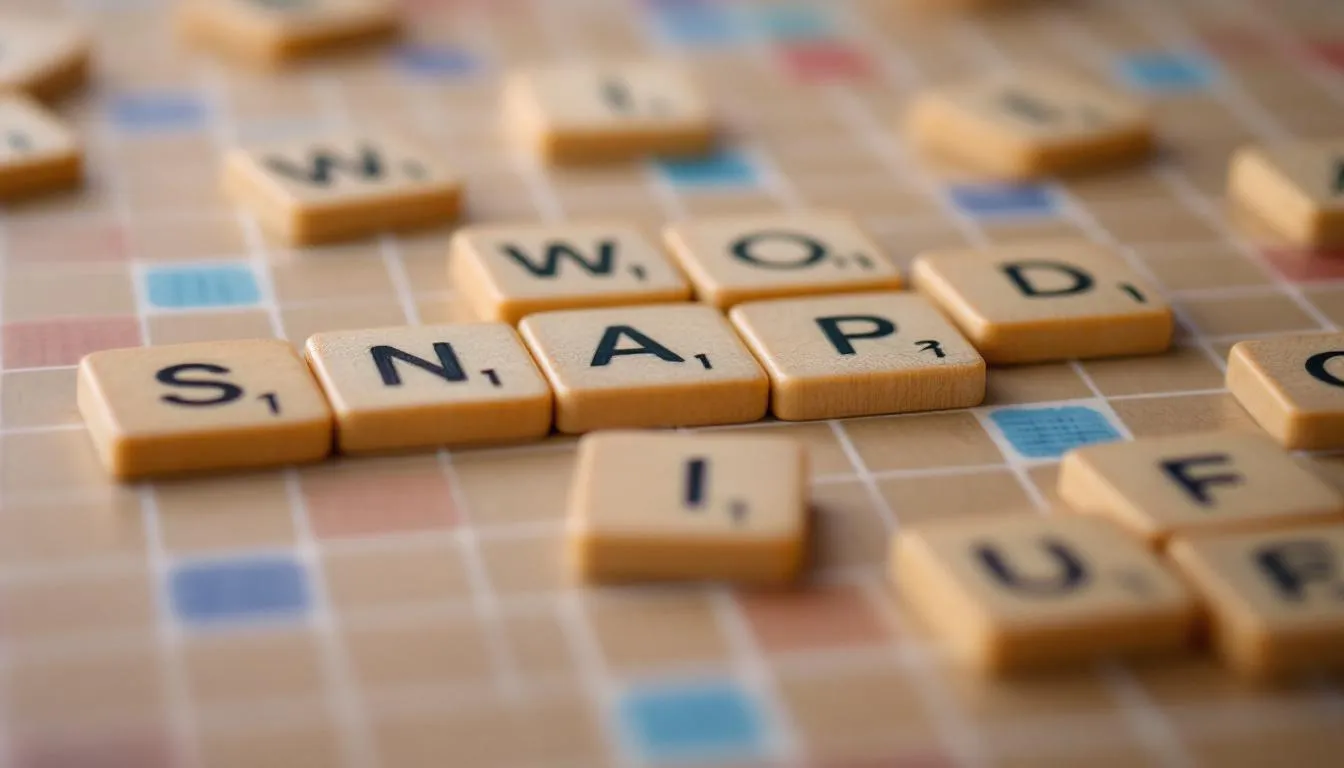
Table of Contents
What Is Scrabble?
Scrabble is a board game where two to four players score points by forming words from individual lettered tiles on a 15-by-15 grid. Each letter has a point value based on its frequency in English — common letters like E and A are worth 1 point, while rare letters like Q and Z are worth 10. Players draw seven tiles from a bag, create words on the board crossword-style, and score based on letter values plus bonus squares.
It sounds simple. It isn’t. At the competitive level, Scrabble is a deeply strategic game involving vocabulary knowledge, probability calculation, board control, and psychological warfare. The gap between a casual player and a tournament player is enormous.
How It Started
Alfred Mosher Butts, an unemployed architect in New York City, invented the game during the Great Depression. He initially called it “Lexiko,” then “Criss-Crosswords.” Butts hand-counted letter frequencies by analyzing the front page of The New York Times to determine how many of each tile to include and what each should be worth. That frequency analysis from the 1930s still governs every Scrabble game played today.
Butts couldn’t get any game company interested. In 1948, James Brunot bought the rights, simplified the rules, renamed it “Scrabble,” and began manufacturing it in his living room. Sales were modest — about 2,400 sets in 1949.
Then something odd happened. In 1952, Jack Straus, the president of Macy’s department store, played Scrabble on vacation. He loved it, was shocked that Macy’s didn’t carry it, and placed a large order. Word spread. Within two years, Brunot’s small operation couldn’t keep up with demand. By 1954, nearly 4 million sets had been sold. Scrabble went from obscurity to cultural phenomenon in about 18 months.
Today, Scrabble is sold in 121 countries and available in 29 languages. An estimated 150 million sets have been sold worldwide. About one-third of American households own a set.
The Rules in Brief
Each player starts by drawing seven tiles from a bag containing 100 tiles. The first player forms a word through the center square. Subsequent players must connect new words to existing ones, crossword-style — every new tile placement must create valid words in all directions.
The board has bonus squares: double letter score (light blue), triple letter score (dark blue), double word score (pink), and triple word score (red). Strategic use of these squares — especially the triple word scores in the corners — dramatically affects scoring.
After playing a word, you draw replacement tiles to maintain seven on your rack. You can also choose to exchange tiles instead of playing a word, forfeiting your turn but potentially getting better letters.
The game ends when the tile bag is empty and one player uses all remaining tiles — or when all players pass consecutively. Unused tiles on your rack subtract from your final score.
What Tournament Play Looks Like
Competitive Scrabble is a different animal from the family game you played growing up. Tournament players study word lists obsessively. The Official Scrabble Players Dictionary contains about 187,000 valid words, and serious competitors know tens of thousands of them — including obscure two-letter words (QI, ZA, JO, XI) and “bingo” words (using all seven tiles for a 50-point bonus).
Time pressure adds intensity. Tournament games use chess clocks, typically giving each player 25 minutes total. That means quick decisions and intense mental calculation.
The strategic depth is surprising. Good players think several moves ahead, considering not just their current play but how it opens or closes the board for their opponent. Playing a high-scoring word that gives your opponent access to a triple word score might be worse than playing a modest word that blocks it.
Rack management is critical. Keeping a balanced mix of vowels and consonants, holding onto blanks and S tiles for high-scoring opportunities, and knowing when to exchange bad tiles — these decisions separate good players from great ones.
Board control matters enormously. “Opening” the board (creating opportunities for long words and bonus squares) benefits players with strong vocabularies. “Closing” the board (blocking bonus squares and limiting word-placement options) helps when you’re ahead or facing a stronger opponent.
The Words Nobody Actually Knows
Here’s a quirky reality of competitive Scrabble: top players know words they can’t define. They’ve memorized letter combinations from word lists without knowing what the words mean. QI? It’s the Chinese concept of life force. QANAT? An irrigation tunnel. ZAX? A tool for cutting roofing slates. Most tournament players learned these words purely as valid tile arrangements.
This bothers some people. Is it really a “word game” if players don’t know what the words mean? Tournament players argue it’s a strategy game that uses words as its medium, the same way chess uses pieces. You don’t need to know the history of bishops to play chess. The words are tools, not the point.
The two-letter word list is particularly important. There are about 100 valid two-letter words in tournament Scrabble, and knowing them unlocks plays that seem impossible. Placing a single tile to create two or three intersecting two-letter words can score surprisingly well.
Scrabble Around the World
Different language versions of Scrabble have different tile distributions and point values. French Scrabble has more accent tiles. German Scrabble includes umlauts. The Arabic version arranges tiles right-to-left.
International competition reveals interesting cultural differences. Thai Scrabble players are among the world’s best at English Scrabble — remarkable since English isn’t their first language. They treat it purely as a pattern-matching game, memorizing valid English words as abstract combinations rather than meaningful vocabulary. This approach has won multiple world championships.
The World Scrabble Championship has been held since 1991. Winners have come from the United States, Canada, Thailand, Nigeria, New Zealand, and the United Kingdom — a genuinely global game with a genuinely global competitive scene.
Why People Still Play
In an age of video games and streaming, a tile-based word game from the 1930s keeps thriving. Part of the appeal is accessibility — you can play Scrabble at any age, at any level, with minimal equipment. A game between a 10-year-old and an 80-year-old works perfectly fine.
But the real hook is that Scrabble rewards a specific kind of intelligence — pattern recognition, vocabulary, and strategic thinking — in a way that feels fair and tangible. You placed those tiles. You found that word. You earned those points. In a world of algorithmic entertainment, there’s something satisfying about a game where your brain is genuinely the whole show.
Frequently Asked Questions
How many tiles are in a Scrabble game?
A standard English Scrabble set contains 100 tiles — 98 letter tiles and 2 blank tiles (which can represent any letter). The distribution isn't random: there are 12 E tiles but only 1 each of Z, Q, X, J, and K. The distribution mirrors letter frequency in English, so common letters appear more often.
What's the highest possible Scrabble score for a single word?
The theoretical maximum for a single word play is debated, but the highest verified single-word score in competition is 365 points for QUIXOTRY. The highest possible game score is theoretically over 4,000 points, though real competitive games typically see final scores between 300-500 points per player.
Is Scrabble a game of skill or luck?
Both, but skill dominates over time. Tile draws introduce randomness — you might get stuck with all vowels or draw the Q without a U. But top players consistently beat weaker players because they know more words, understand board positioning, manage their tile rack strategically, and make better decisions about when to exchange tiles. In a single game, luck can swing outcomes. Over many games, the better player wins.
Further Reading
Cite this article
APA
WhatIs.site. (2025). What Is Scrabble?. Retrieved May 27, 2026, from https://whatis.site/scrabble MLA
"What Is Scrabble?." WhatIs.site, July 15, 2025, https://whatis.site/scrabble. Accessed May 27, 2026. Chicago
WhatIs.site. "What Is Scrabble?." Last modified May 12, 2026. https://whatis.site/scrabble. HTML
<a href="https://whatis.site/scrabble">What Is Scrabble?</a> — WhatIs.site Related Articles
What Is Skill-Based Gaming?
Skill-based gaming rewards player ability over luck. Learn how skill-based games work, their rise in esports, and the debate around chance vs. talent.
languageWhat Is Semantics?
Semantics is the branch of linguistics that studies meaning — how words, phrases, sentences, and texts convey information.