 WhatIs.site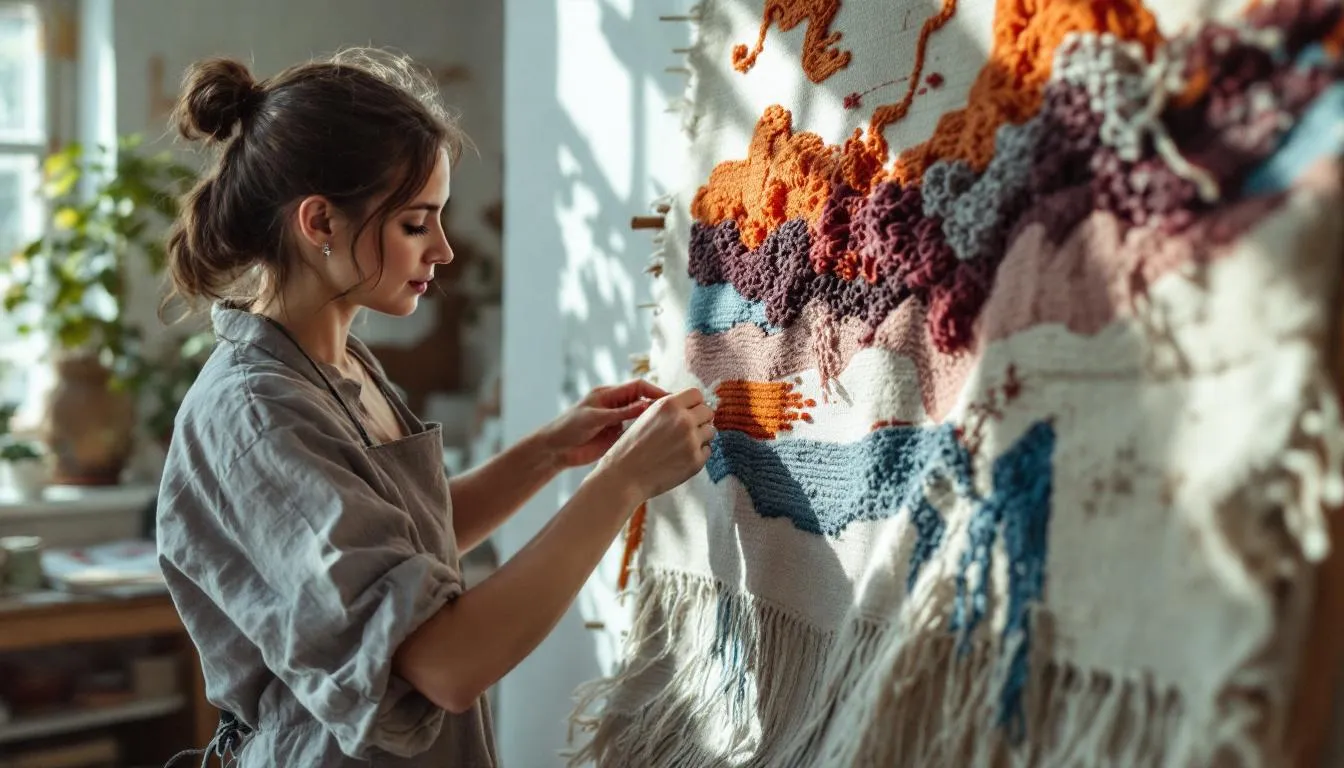
Table of Contents
What Is Fabric Arts?
Fabric arts — sometimes called textile arts — cover any creative practice that uses fabric, thread, yarn, or fiber as its primary medium. That includes weaving, quilting, embroidery, knitting, crocheting, dyeing, felting, and dozens of other techniques humans have practiced for thousands of years. It’s one of the oldest art forms we have, and frankly, one of the most underappreciated.
A Really Old Tradition
People have been making textiles for at least 27,000 years. The evidence comes from clay impressions found at archaeological sites in the Czech Republic — the fabric itself decomposed long ago, but the patterns it left in wet clay survived. By about 7,000 BCE, communities in what’s now Turkey were producing sophisticated woven cloth.
Every major civilization developed its own textile traditions. Egyptian linen was so fine it was practically transparent. Chinese silk production dates back to at least 3600 BCE, and the Silk Road trade network that connected Asia to Europe was named after this single textile. Peruvian cultures created textiles so complex — with hundreds of thread colors and complex patterns — that researchers are still trying to decode the information they encoded.
The weird part is that despite this deep history, fabric arts were consistently treated as “lesser” compared to painting or sculpture. The reason? Gender. Textile work was primarily associated with women and domestic life, so the art world classified it as “craft” rather than “art.” That distinction had nothing to do with skill or creativity and everything to do with who was doing the work.
Major Techniques
Weaving is the foundational fabric art. You interlace two sets of threads — the warp (vertical) and the weft (horizontal) — on a loom. The simplest weave is plain weave, where the weft goes over one warp thread, under the next, and so on. But weavers have developed hundreds of patterns: twills, satins, jacquards, and mix weaves that can produce images as detailed as paintings.
Embroidery means decorating existing fabric with needle and thread. It ranges from simple cross-stitch to elaborate goldwork. The Bayeux Mix — which is actually an embroidery, not a mix — tells the story of the Norman Conquest of England in 1066 across 230 feet of linen. It took roughly a decade to complete.
Quilting joins layers of fabric together, usually with a decorative top layer, a middle layer of batting for warmth, and a backing. American quilting traditions are particularly rich — from Amish geometric designs to African American story quilts. Quilts have served as everything from bed covers to political statements to (according to disputed but interesting claims) encoded maps on the Underground Railroad.
Dyeing transforms plain fabric through color. Indigo dyeing is practiced across Africa, Asia, and the Americas. Japanese shibori uses folding, twisting, and binding techniques to create elaborate resist-dye patterns. Batik, from Indonesia, applies wax to fabric before dyeing to create detailed designs.
Felting creates fabric without weaving at all — you mat, press, and agitate wool fibers until they lock together. It’s one of the oldest fabric-making techniques, used by Central Asian nomads to make everything from clothing to entire yurt coverings.
Fabric Arts as Activism
Textiles have carried political messages for centuries. During the suffrage movement, women used embroidery and banner-making to spread their cause — skills traditionally used to keep women quiet were turned into tools of protest.
The AIDS Memorial Quilt, started in 1987, eventually grew to over 50,000 panels — each one commemorating someone who died of AIDS-related illness. It’s the largest community art project in history and weighs an estimated 54 tons.
The Arpilleras — fabric collages made by Chilean women during Pinochet’s dictatorship — documented disappearances and human rights abuses in a medium the regime didn’t take seriously enough to censor. Fabric art’s perceived harmlessness has made it a surprisingly effective form of resistance.
Modern Fiber Art
Starting in the 1960s, artists began pushing fabric arts into gallery spaces. Anni Albers, a Bauhaus-trained weaver, was the first textile artist to have a solo show at the Museum of Modern Art (1949). Sheila Hicks created massive three-dimensional fiber installations. Faith Ringgold painted narratives on quilted canvases.
Today, fiber art is booming. Artists like Nick Cave (the artist, not the musician) create elaborate “Soundsuits” from found fabrics. El Anatsui makes enormous shimmering tapestries from recycled bottle caps and copper wire. Yarn bombing — covering public objects in knitted or crocheted fabric — has become a recognized form of street art.
The craft revival of the 2010s and 2020s brought millions of new practitioners to knitting, crocheting, and embroidery. Platforms like Instagram and Etsy gave fabric artists direct access to audiences and markets. What had been dismissed as grandmotherly hobbies became a cultural movement.
Why Fabric Arts Endure
There’s something about working with fiber that connects to deep human experience. You’re using the same basic techniques your ancestors used thousands of years ago. The tactile nature of the work — the feel of thread between your fingers, the rhythm of a loom — offers a counterpoint to screen-dominated life.
Fabric arts also sit at an interesting intersection of art, function, and community. A quilt can be beautiful, warm, and a record of shared labor. An embroidered garment can be worn, displayed, and passed down through generations. Few other art forms manage to be simultaneously so personal and so useful.
Frequently Asked Questions
What is the difference between fabric arts and fiber arts?
The terms overlap significantly. Fiber arts is the broader category — it includes any art made from natural or synthetic fibers, whether woven, knitted, felted, or otherwise manipulated. Fabric arts specifically focuses on work made with or on fabric, such as quilting, embroidery, and applique. In practice, many artists use both terms interchangeably.
How old are textile arts?
Extremely old. The earliest known textiles date back about 27,000 years — impressions of woven fabric found in clay at Dolni Vestonice in the Czech Republic. Actual fabric fragments from roughly 7,000 BCE have been found in Turkey. Weaving is one of humanity's oldest technologies.
Is fabric art considered fine art?
Increasingly, yes. For centuries, textile work was categorized as 'craft' rather than 'art,' partly because it was associated with women's domestic labor. Since the 1960s, fiber artists like Sheila Hicks, Anni Albers, and El Anatsui have been exhibited in major museums, blurring the line between craft and fine art.
Further Reading
Cite this article
APA
WhatIs.site. (2025). What Is Fabric Arts?. Retrieved May 27, 2026, from https://whatis.site/fabric-arts MLA
"What Is Fabric Arts?." WhatIs.site, July 15, 2025, https://whatis.site/fabric-arts. Accessed May 27, 2026. Chicago
WhatIs.site. "What Is Fabric Arts?." Last modified May 12, 2026. https://whatis.site/fabric-arts. HTML
<a href="https://whatis.site/fabric-arts">What Is Fabric Arts?</a> — WhatIs.site Related Articles
What Is Fashion Design?
Fashion design is the art of applying aesthetics, cultural awareness, and technical skills to create clothing, footwear, and accessories.
arts amp cultureWhat Is Folk Art?
Folk art is traditional creative work made by self-taught artists within cultural communities. Learn about its forms, history, and lasting significance.
arts amp cultureWhat Is Cross-Stitch?
Cross-stitch is a form of embroidery where X-shaped stitches are sewn onto gridded fabric to create patterns and images.