 WhatIs.site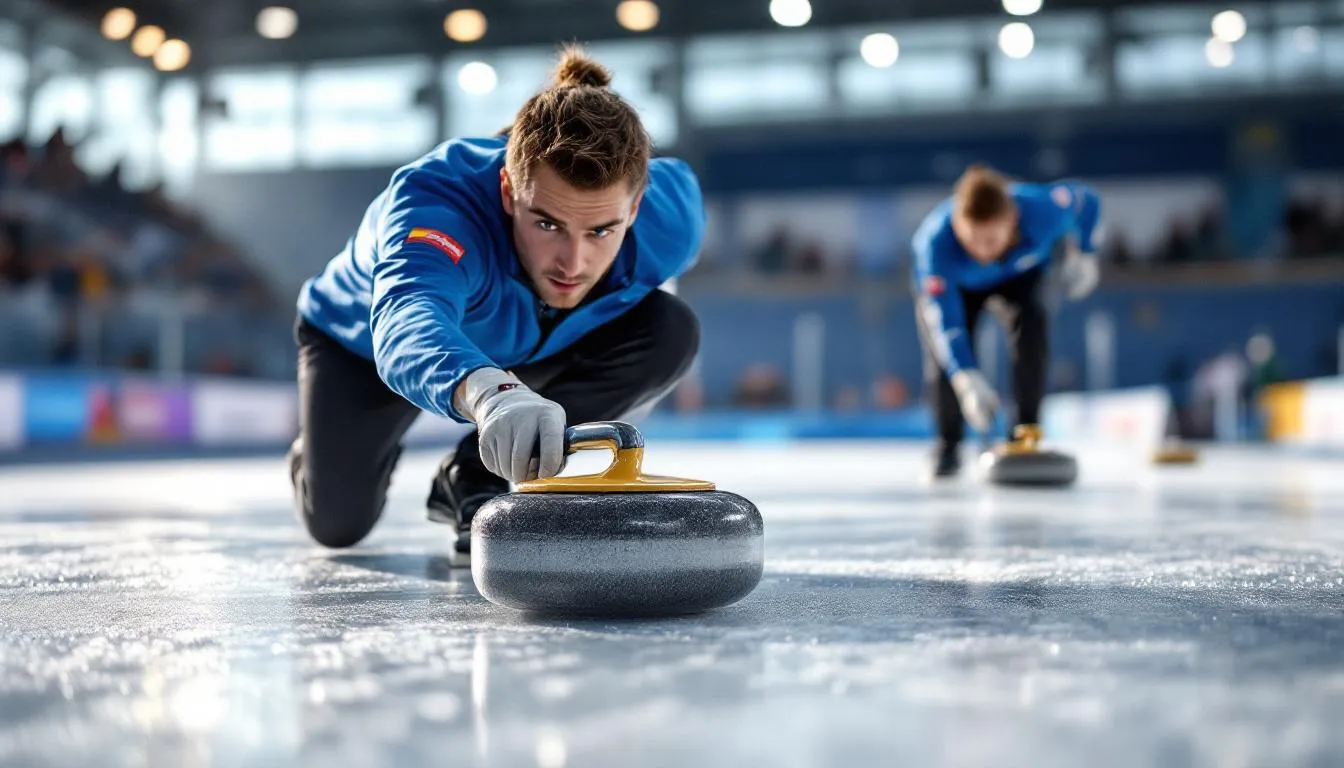
Table of Contents
What Is Curling?
Curling is a team sport played on ice in which players slide 42-pound granite stones down a 150-foot sheet toward a circular target (called the house). Teammates sweep the ice ahead of the moving stone to control its speed and direction. It’s been called “chess on ice” — a description that captures its blend of physical precision and deep strategic thinking.
The Basics
Two teams of four players alternate sliding eight stones each toward the house — a set of concentric circles painted under the ice surface. The center circle is called the button. After all 16 stones are delivered in an “end” (similar to an inning in baseball), the team whose stone is closest to the button scores points — one point for each of their stones that’s closer than the opponent’s nearest stone.
A standard game has 8 or 10 ends. The team with the most points wins. Ties are broken by extra ends.
The stone curls — that’s where the name comes from. When a player releases the stone with a slight rotation, it bends (curls) in the direction of the rotation as it slows. Controlling this curl, combined with sweeping, gives teams remarkable precision over stone placement.
Sweeping: Not Just Housekeeping
The most visually distinctive aspect of curling — and the one that confuses new viewers most — is sweeping. Two teammates frantically scrub the ice ahead of the stone with brooms as it slides down the sheet.
This isn’t decorative. Sweeping serves two precise functions: it extends the stone’s travel distance (by reducing friction through surface heating) and reduces the amount of curl (keeping the stone on a straighter path). A well-timed sweep can mean the difference between a perfectly placed stone and one that stops short or curls too much.
The skip (team captain) stands at the far end, reading the stone’s path and shouting instructions — “Hard!” (sweep vigorously), “Clean!” (light sweeping), or nothing (let it go). The communication between skip and sweepers is constant and urgent during each shot.
Strategy Runs Deep
Curling’s strategic depth is genuinely remarkable. Each shot involves calculating angles, weight (speed), curl, and how the stone will interact with stones already in play.
Guards are stones placed in front of the house to protect scoring stones from being knocked out. Draws are shots aimed to land in a specific position within the house. Takeouts remove opponent stones by hitting them. Freezes place a stone directly against an opponent’s stone, making it difficult to remove without also disturbing the frozen stone.
The team with the “hammer” (last stone advantage in an end) has a significant strategic edge. Teams without the hammer often play defensively — placing guards and trying to steal points. Teams with the hammer play more aggressively, knowing they get the last shot to set up their score.
The most strategic element: sometimes it’s better not to score. If a team scores only one point with the hammer, they’ve gained a point but given the hammer to the opponent. Skilled teams will intentionally “blank” an end (score zero) to keep the hammer for the next end, setting up a bigger scoring opportunity.
The Ice Itself
Curling ice isn’t flat and smooth like skating ice. Before each game, an ice technician sprays tiny water droplets onto the surface, creating a texture called “pebble.” These tiny bumps reduce friction and allow the stones to curl predictably. Without pebble, stones wouldn’t curl at all.
Ice conditions change throughout a game as body heat, humidity, and repeated sweeping alter the pebble texture. Good teams read and adapt to changing ice conditions — a shot that works perfectly in the first end might behave differently by the eighth.
A Scottish Invention
Curling originated in medieval Scotland, with the oldest known curling stone dating to 1511. Early games used whatever flat stones were available (some with handles, some without) on frozen ponds and lochs. The sport formalized over centuries, with the Royal Caledonian Curling Club establishing rules in 1838.
Scottish immigrants brought curling to Canada, where it became enormously popular — Canada has more curling clubs (over 1,000) than any other country. The sport has been part of the Winter Olympics since 1998 (after a demonstration appearance in 1924 and 1988).
The 2018 and 2022 Winter Olympics generated significant interest in curling among casual viewers, particularly in the United States, where the sport’s combination of quirky charm and genuine tension made it a surprise ratings hit.
The Spirit of Curling
Curling has an unusual cultural emphasis on sportsmanship, formally codified as the “Spirit of Curling.” Players call their own fouls (called “burned stones” — touching a stone in motion). Winners buy the losing team a drink after the game. Handshakes and congratulations are mandatory, not optional.
This culture of self-policing and mutual respect isn’t just tradition — it’s written into the World Curling Federation’s rules: “Curlers play to win, but never to humble their opponents.” With trash talk and gamesmanship in other sports, curling’s politeness feels both anachronistic and refreshing.
Getting Started
Curling is one of the most accessible winter sports for beginners. Most curling clubs offer “learn to curl” sessions for $25-$50 that include equipment, instruction, and a mini-game. No prior experience or athletic ability is required — curling is one of the few Olympic sports where people pick it up in their 30s, 40s, or beyond and play competitively.
The sport’s gentle learning curve, social atmosphere, and strategic depth make it addictive once you try it. Just don’t call it shuffleboard on ice in front of curlers. They’ve heard it before, and they’re too polite to tell you how wrong it is.
Frequently Asked Questions
Why do curlers sweep the ice?
Sweeping heats the ice surface slightly, reducing friction and allowing the stone to travel farther and straighter. Vigorous sweeping can extend a stone's path by 3 to 5 feet and reduce its curl (sideways movement) by up to 50%. Knowing when and how hard to sweep is a critical tactical skill that can determine the outcome of a game.
How much does a curling stone weigh?
A regulation curling stone weighs between 38 and 44 pounds (17.2 to 19.96 kg), with most competition stones weighing about 42 pounds. Stones are made from a specific type of granite sourced almost exclusively from two locations: Ailsa Craig island in Scotland and the Trefor Granite Quarry in Wales. The granite's unique density and low water absorption make it ideal.
How is curling scored?
After all 16 stones are delivered in an end (8 per team), only one team scores. The team with the stone closest to the center (button) scores one point for each of their stones that is closer to the button than the opposing team's closest stone. A game consists of 8 or 10 ends. Strategy often involves choosing between scoring multiple points and preventing the opponent from scoring.
Further Reading
Cite this article
APA
WhatIs.site. (2025). What Is Curling?. Retrieved May 27, 2026, from https://whatis.site/curling MLA
"What Is Curling?." WhatIs.site, July 15, 2025, https://whatis.site/curling. Accessed May 27, 2026. Chicago
WhatIs.site. "What Is Curling?." Last modified May 12, 2026. https://whatis.site/curling. HTML
<a href="https://whatis.site/curling">What Is Curling?</a> — WhatIs.site Related Articles
What Is Ice Hockey?
Ice hockey is a team sport played on an enclosed ice rink where two teams of six skaters each use sticks to shoot a vulcanized rubber puck into the opposing.
sportsWhat Is Ice Skating?
Ice skating is moving across ice on metal-bladed boots, using the blade's thin edge to glide with remarkably little friction.
everyday conceptsWhat Is Bowling?
Bowling is a sport in which players roll a weighted ball down a long, narrow lane to knock down a group of pins arranged in a triangular formation at the far.
everyday conceptsWhat Is Chess?
Chess is a two-player strategy game played on an 8x8 board with 32 pieces — 16 per side.
sportsWhat Is Rafting?
Rafting — usually called whitewater rafting — is the recreational activity of riding an inflatable raft through sections of a river that have varying degrees.