 WhatIs.site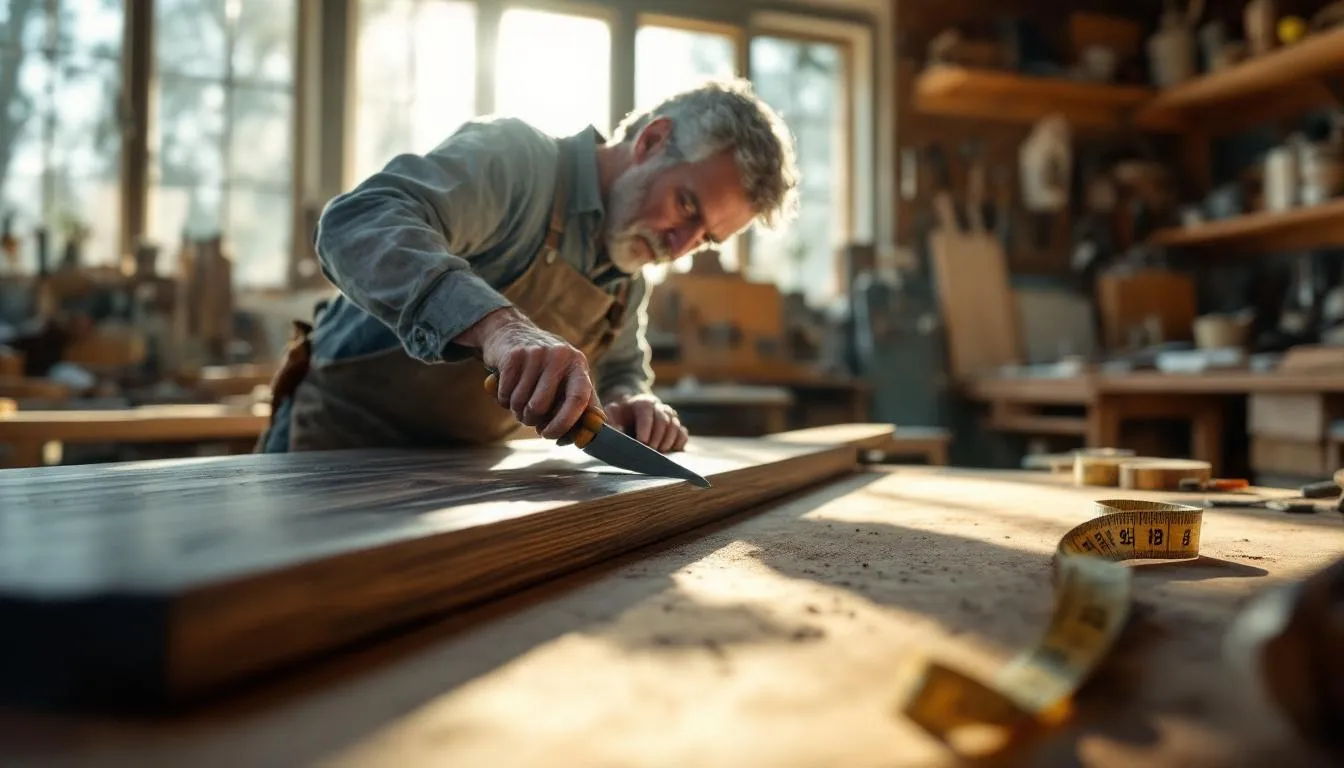
Table of Contents
What Is Cabinet Making?
Cabinet making is the skilled craft of designing and constructing fine furniture, cabinets, and wooden storage pieces using precise joinery, careful wood selection, and refined finishing techniques. It sits at the higher end of woodworking — where structural soundness meets aesthetic beauty, and joints that could be hidden are instead executed with such precision they become decorative features themselves.
Craft vs. Production
There’s an important distinction between cabinet making as craft and kitchen cabinet installation as a trade. The craft tradition — hand-selecting wood, cutting joints, fitting and finishing by hand — produces one-of-a-kind or small-run pieces that are as much art as furniture. The trade of installing manufactured kitchen cabinets is valuable work but involves different skills and goals.
This article focuses on the craft tradition, though the skills overlap. A cabinet maker who can cut a perfect dovetail by hand can certainly install manufactured cabinets — but the reverse isn’t necessarily true.
Historical Roots
Cabinet making as a distinct trade emerged in Europe during the 17th century, separating from general carpentry as furniture became more refined. The term “cabinetmaker” (from the French ébéniste) specifically referred to craftspeople who made fine furniture, as opposed to joiners who made doors, window frames, and other architectural woodwork.
The great historical periods of furniture — Chippendale (mid-18th century English), Shaker (19th century American), Arts and Crafts (late 19th century), Art Deco (1920s-1930s), and Danish Modern (mid-20th century) — each produced distinctive approaches to form, ornament, and construction. Many contemporary cabinet makers draw inspiration from these traditions while incorporating modern materials and techniques.
Essential Joinery
The quality of a piece of furniture is ultimately determined by its joints — how the pieces of wood connect. Machine-made furniture uses screws, nails, and glue. Craft cabinet making uses interlocking wood joints that are often stronger and always more beautiful.
Dovetails — Interlocking fan-shaped pins and tails that resist being pulled apart. The gold standard for drawer construction. Hand-cut dovetails are a mark of craftsmanship; their slight irregularities distinguish handwork from machine-cut uniformity.
Mortise and tenon — A projecting piece (tenon) fits into a corresponding hole (mortise). This joint has been used for thousands of years in both furniture and timber framing. Variations include through-tenons (visible on the outside), wedged tenons, and drawbored joints (locked with a wooden peg).
Tongue and groove — Matching profiles on adjacent boards lock together, commonly used for panel construction and tabletops. The joint allows wood to expand and contract with humidity changes without splitting.
Finger joints (box joints) — Similar to dovetails but with straight-sided interlocking fingers. Simpler to cut and still very strong.
Bridle joints — An open mortise and tenon, where both pieces are visible. Used in frame construction and considered both functional and decorative.
Tools of the Trade
Hand Tools
A hand-tool cabinet maker works with planes (smoothing surfaces), chisels (cutting joints), saws (rip saws, crosscut saws, dovetail saws, coping saws), marking tools (gauge, square, knife), and sharpening equipment. The quality of hand work depends directly on the sharpness of edge tools — learning to sharpen is arguably the most important skill in woodworking.
Power Tools
Modern cabinet shops typically include a table saw, bandsaw, jointer (flattening one face), planer (thickening to dimension), router (shaping profiles), drill press, and various sanders. CNC (computer numerical control) routers enable precise, repeatable cutting of complex shapes.
Most professional cabinet makers use a combination of power tools for efficiency and hand tools for refinement. Power tools do the heavy dimensioning; hand tools provide the final fit and finish.
The Design Process
Custom cabinet making begins with client consultation — understanding needs, preferences, space constraints, and budget. Drawings (increasingly done in CAD software like SketchUp or SolidWorks) establish proportions, dimensions, and details. Material selection considers wood species, grain pattern, color, and cost.
Good furniture design follows principles of proportion (the golden ratio appears frequently in historical furniture), visual balance, and practical function. A beautiful cabinet that doesn’t hold what it needs to hold is a failure. So is a functional cabinet that’s ugly. The craft demands both.
Modern Cabinet Making
The field has evolved significantly. CNC technology allows small shops to produce work with factory precision while maintaining custom flexibility. Sustainable forestry) certification (FSC) helps conscientious makers source wood responsibly. Modern finishes (water-based polyurethane, hardwax oils, conversion varnish) offer better performance and lower environmental impact than traditional lacquers.
The maker movement has renewed interest in handmade furniture. Instagram and YouTube showcase remarkable work by solo craftspeople and small shops, connecting makers directly with customers who value handwork and are willing to pay for it.
Career paths include custom furniture shops, kitchen and bath cabinet companies, architectural millwork, restoration and conservation, museum preparation, and teaching. The median salary for cabinet makers in the U.S. is approximately $40,000-50,000, with experienced custom builders earning significantly more.
Why It Matters
In a world of flat-pack furniture and planned obsolescence, well-made wooden furniture is counter-cultural. A properly built cabinet — with joints that don’t rely on screws, wood chosen for its beauty, and surfaces finished to highlight the grain — will outlast its maker by generations. It will be passed down, repaired if needed, and appreciated by people who weren’t born when it was built.
That durability is the ultimate argument for cabinet making. Not because old things are inherently better, but because making something well enough to last is a form of respect — for the material, for the craft, and for the people who will use it after you’re gone.
Frequently Asked Questions
What is the difference between cabinet making and carpentry?
Carpentry involves structural woodwork — framing houses, building decks, installing doors and windows. Cabinet making focuses on fine furniture and built-in storage, requiring tighter tolerances, more refined joinery, and greater attention to aesthetics and finish. Carpenters work in fractions of an inch; cabinet makers often work in fractions of a millimeter.
What wood is best for cabinet making?
Common choices include cherry (warm color, ages beautifully), walnut (rich dark tones), maple (hard, light-colored), oak (strong, prominent grain), and mahogany (classic fine furniture wood). Plywood with hardwood veneer is widely used for panel construction in modern cabinetry. Wood selection depends on the project, budget, and desired appearance.
How long does it take to learn cabinet making?
Basic cabinet making skills can be developed in 6-12 months of dedicated practice. Competent professional work typically requires 2-4 years of training through apprenticeship, trade school, or intensive self-study. Mastery — the ability to design and execute complex pieces with refined joinery and flawless finishing — takes 5-10+ years of continuous practice.
Further Reading
Cite this article
APA
WhatIs.site. (2025). What Is Cabinet Making?. Retrieved May 27, 2026, from https://whatis.site/cabinet-making MLA
"What Is Cabinet Making?." WhatIs.site, July 15, 2025, https://whatis.site/cabinet-making. Accessed May 27, 2026. Chicago
WhatIs.site. "What Is Cabinet Making?." Last modified May 12, 2026. https://whatis.site/cabinet-making. HTML
<a href="https://whatis.site/cabinet-making">What Is Cabinet Making?</a> — WhatIs.site Related Articles
What Is Carpentry?
Carpentry is the skilled trade of cutting, shaping, and assembling wood (and increasingly, engineered wood products) to construct buildings, structures.
arts amp cultureWhat Is Architecture?
Architecture is the art and science of designing buildings and structures. Learn about architectural styles, key principles, famous architects, and careers.
arts amp cultureWhat Is Art History?
Art history is the scholarly study of visual arts — painting, sculpture, architecture, photography, and other visual forms — examining how they were created.
technologyWhat Is Design Patterns?
A design pattern is a reusable, generalized solution to a commonly occurring problem in software design.
scienceWhat Is Materials Science?
Materials science is the study of how a material's internal structure — its atoms, their arrangement, and their bonding.