 WhatIs.site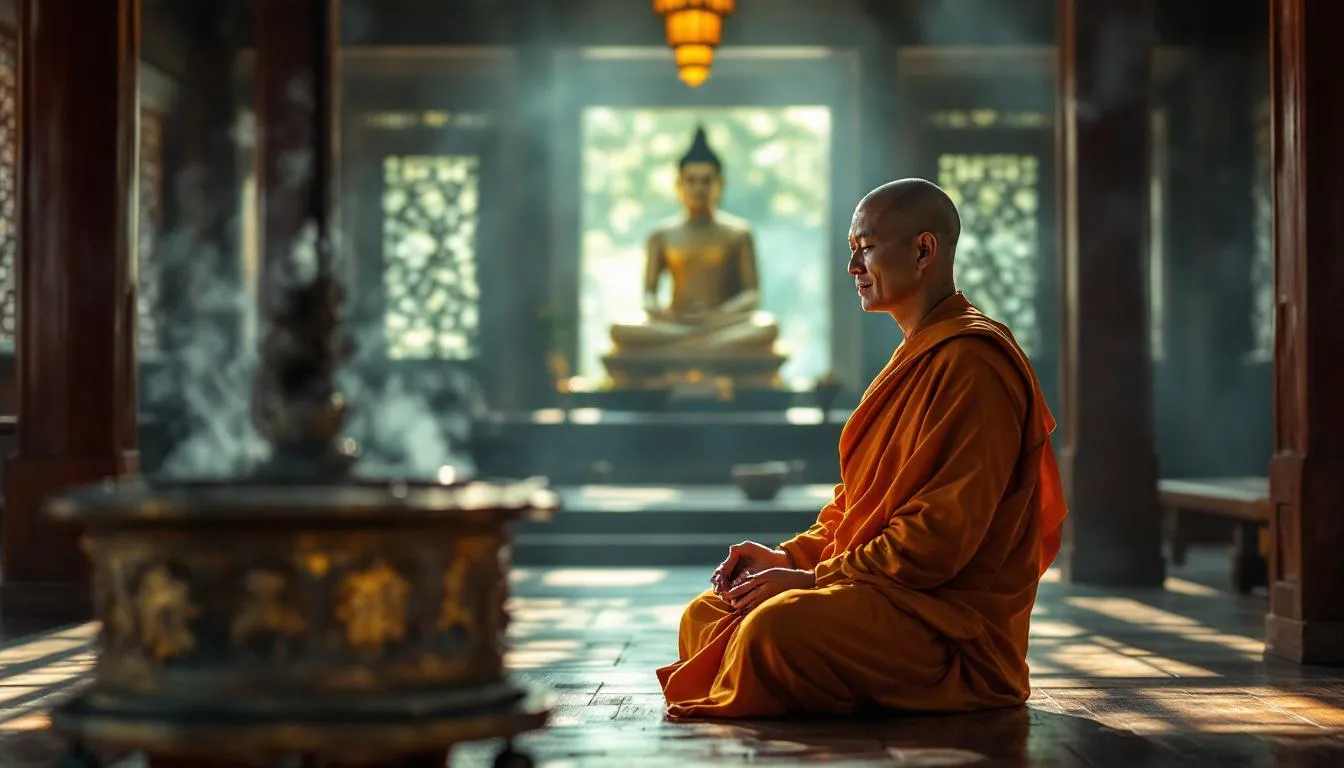
Table of Contents
What Is Buddhism?
Buddhism is a religion and philosophical system founded in the 5th century BCE by Siddhartha Gautama, known as the Buddha, based on the principle that suffering arises from attachment and craving and can be ended through ethical conduct, mental discipline, and wisdom — specifically through the Four Noble Truths and the Noble Eightfold Path.
The Man Behind the Teaching
Every major religion has an origin story, but Buddhism’s is unusually human. No divine revelation, no burning bush, no angelic visitation. Just a man who got deeply uncomfortable with the suffering he saw and decided to do something about it.
Siddhartha Gautama was born around 563 BCE in Lumbini, in present-day Nepal, to a royal family of the Shakya clan. His father, King Suddhodana, reportedly went to great lengths to shield the young prince from suffering — surrounding him with luxury, youth, and beauty inside the palace walls.
The traditional account says Siddhartha first encountered suffering during four trips outside the palace, where he saw an old person, a sick person, a dead person, and finally an ascetic holy man who seemed at peace despite having nothing. These “Four Sights” shattered his sheltered worldview. At 29, he abandoned his palace, his wife, and his infant son to seek the answer to a single question: Why do beings suffer, and how can suffering end?
For six years, he tried everything. He studied under the leading meditation teachers of his time. He practiced extreme asceticism — fasting until his spine could be felt through his stomach, according to texts. None of it satisfied him. The teachers’ methods brought temporary states but not permanent liberation. Extreme self-denial just produced a weakened body and a foggy mind.
He eventually sat under a Bodhi tree in Bodh Gaya (modern Bihar, India) and resolved not to rise until he understood. After a night of intense meditation, he reached what Buddhists call enlightenment — a complete understanding of the nature of suffering, its causes, and its cessation. He was 35.
He spent the remaining 45 years of his life teaching. He died around 483 BCE at age 80 in Kushinagar, India — reportedly from food poisoning after eating a meal offered by a blacksmith named Cunda.
Here’s what makes the Buddha different from founders of other religions: he never claimed to be divine. He didn’t claim to be a messenger of God. He said he was a human being who discovered something through his own effort — and that anyone else could discover the same thing through the same effort. That’s a remarkably democratic claim for a religious founder.
The Four Noble Truths: The Core Teaching
The Buddha’s first sermon after his enlightenment, delivered to five ascetics in Deer Park at Sarnath, laid out the Four Noble Truths. Everything else in Buddhism builds on these.
The First Noble Truth: Dukkha (Suffering Exists)
The Pali word “dukkha” is usually translated as “suffering,” but that’s only partly right. It also means dissatisfaction, unease, imperfection — the fundamental unsatisfactoriness of conditioned existence.
The Buddha wasn’t being pessimistic. He wasn’t saying everything is terrible. He was pointing out something more subtle: even pleasant experiences carry a seed of dissatisfaction because they don’t last. You get the promotion — and then worry about the next one. You fall in love — and then fear losing the person. The chocolate cake is amazing — for about three bites, then it’s just cake.
Dukkha shows up in three forms:
Ordinary suffering — pain, illness, aging, death. The obvious stuff.
Suffering of change — the fact that pleasant experiences end. The vacation is over. The kids grow up. Your favorite restaurant closes.
Existential suffering — the deepest level, the basic unsatisfactoriness of a conditioned self that’s constantly changing, constantly wanting, and unable to find permanent ground to stand on.
This isn’t depression. It’s diagnosis. You can’t fix a problem you haven’t identified.
The Second Noble Truth: Samudaya (The Cause of Suffering)
Suffering arises from craving (tanha) — the persistent thirst for pleasure, existence, and non-existence. We want things. We want experiences. We want to become something. We want unpleasant things to stop. This constant wanting is the engine of suffering.
Craving operates through attachment — clinging to things, people, experiences, ideas, and identities as if they were permanent. But nothing is permanent. Everything changes. Clinging to what changes is like gripping sand — the tighter you squeeze, the faster it slips away.
The second layer is ignorance (avijja) — not understanding the true nature of reality. We treat impermanent things as permanent. We treat things that can’t provide lasting satisfaction as sources of lasting happiness. We treat the self as a fixed, unchanging entity when it’s actually a process.
This isn’t moralizing — it’s a claim about how the mind works. The Buddha argued that understanding the mechanism of craving and attachment is the first step to freedom from it.
The Third Noble Truth: Nirodha (The End of Suffering)
Suffering can end. This is the good news. By understanding craving and letting go of attachment, it’s possible to experience a state free from suffering — nirvana (or nibbana in Pali).
Nirvana isn’t a place. It’s not heaven. It’s the cessation of craving, hatred, and delusion. The texts describe it negatively — the absence of suffering rather than the presence of bliss — partly because language is inadequate to describe it and partly because describing it as a positive state would just create another thing to crave.
The Buddha compared it to the extinguishing of a fire. When a fire goes out, you don’t ask “where did the fire go?” — the question doesn’t apply. The conditions that sustained it simply ceased.
The Fourth Noble Truth: Magga (The Path)
There’s a specific path to the end of suffering — the Noble Eightfold Path. This is the practical program, the “how” after the “what” and “why.”
The Noble Eightfold Path
The Eightfold Path is organized into three categories: wisdom, ethical conduct, and mental discipline. They’re not sequential steps — they’re practiced simultaneously, each supporting the others.
Wisdom (Prajna)
Right View — Understanding the Four Noble Truths, impermanence, non-self, and the nature of suffering. This isn’t blind faith; it’s experiential understanding developed through study and meditation.
Right Intention — Committing to ethical and mental self-improvement. Renouncing cruelty, ill will, and harmful behavior. Setting your internal compass toward wisdom and compassion rather than selfishness and hostility.
Ethical Conduct (Sila)
Right Speech — Abstaining from lying, divisive speech, harsh words, and idle gossip. This is surprisingly practical — most interpersonal suffering involves speech. Gossip damages relationships. Harsh words create enemies. Lies erode trust. The Buddha considered speech important enough to give it its own path factor.
Right Action — Abstaining from killing, stealing, and sexual misconduct. These map roughly to basic ethical principles found across cultures — which is the point. They’re not arbitrary rules but observations about what behaviors create suffering.
Right Livelihood — Earning a living in a way that doesn’t harm others. The Buddha specifically mentioned five trades to avoid: dealing in weapons, living beings (slavery or trafficking), meat, intoxicants, and poisons. The principle extends to any work that causes unnecessary harm.
Mental Discipline (Samadhi)
Right Effort — Preventing unwholesome mental states from arising, abandoning ones that have arisen, cultivating wholesome states, and maintaining ones already present. This is active mental management — not passive acceptance of whatever thoughts show up.
Right Mindfulness — Maintaining clear awareness of body, feelings, mind states, and mental objects. This is the practice most associated with Buddhism in the West — paying attention to present-moment experience without judgment.
Right Concentration — Developing focused, unified states of mind through meditation. The texts describe four jhanas (absorption states) of increasingly refined concentration and tranquility.
The path factors work together. You can’t develop genuine concentration without ethical conduct (guilt and anxiety disturb focus). You can’t maintain ethical conduct without wisdom (you need to understand why ethics matter). Each factor supports and reinforces the others.
Key Concepts That Shape Buddhist Thought
Beyond the Four Noble Truths and Eightfold Path, several concepts are central to Buddhist understanding.
Impermanence (Anicca)
Everything changes. Everything. Your body, your thoughts, your emotions, your relationships, civilizations, planets, the universe itself. The Buddha considered impermanence not a philosophical abstraction but a direct observation — meditate carefully enough, and you can see that even what seems stable is in constant flux.
The practical implication: attachment to impermanent things guarantees suffering. Not because impermanent things are bad, but because treating them as permanent sets you up for loss.
Non-Self (Anatta)
This is Buddhism’s most radical and counterintuitive claim: there is no permanent, unchanging self. What you call “I” is a constantly changing process — a collection of physical form, sensations, perceptions, mental formations, and consciousness, all in flux.
The five aggregates (skandhas) — form, feeling, perception, mental formations, consciousness — constitute what we experience as a person. But none of them is a fixed “self.” Each changes moment to moment. The “you” of ten years ago shares almost no physical atoms with the “you” of today. Your personality, beliefs, and preferences have shifted. What exactly is the unchanging “you”?
This doesn’t mean you don’t exist. It means you don’t exist the way you think you do — as a fixed, independent entity. You’re more like a river: real, experienceable, but constantly flowing and never quite the same twice. Compare this to Stoicism, which similarly questions our assumptions about identity, though through different reasoning.
Karma and Rebirth
Karma in Buddhism isn’t cosmic justice or reward-and-punishment. It’s simpler than that: actions have consequences. Intentional actions — physical, verbal, and mental — create imprints that influence future experience. Generous actions tend to create conditions for happiness. Cruel actions tend to create conditions for suffering.
Rebirth extends this beyond a single lifetime. Consciousness continues after death, shaped by accumulated karma, into a new life. This cycle of birth, death, and rebirth (samsara) continues until one achieves nirvana.
Different Buddhist traditions interpret rebirth differently. Some take it literally — you will be reborn as a specific being in a specific area. Others interpret it more metaphorically — “rebirth” happens moment to moment as the self is constantly reconstructed. This interpretive diversity is characteristic of Buddhism generally.
Dependent Origination (Pratityasamutpada)
Nothing exists independently. Everything arises in dependence on causes and conditions. A tree depends on soil, water, sunlight, and seed. Your mood depends on sleep, nutrition, social interaction, and brain chemistry. Even what seems most solid and independent is actually a web of interconnected conditions.
This principle underlies all Buddhist thought. Suffering arises from conditions (craving and ignorance) and ceases when those conditions are removed. Nothing is inherently anything — things are what they are because of their conditions.
The Major Traditions
Buddhism split into distinct schools early in its history, much like Christianity split into Catholic, Orthodox, and Protestant branches.
Theravada: The Southern School
Theravada (“Teaching of the Elders”) claims to preserve the original teachings most faithfully. It’s based on the Pali Canon, the oldest surviving complete Buddhist scripture, and emphasizes monastic practice and individual liberation.
The ideal figure in Theravada is the arahant — someone who has achieved nirvana through personal effort and practice. Monks and nuns are central; they follow 227 rules (311 for nuns) covering every aspect of daily life.
Theravada is practiced mainly in Sri Lanka, Myanmar, Thailand, Laos, and Cambodia. About 150 million people practice Theravada Buddhism.
Mahayana: The Northern School
Mahayana (“Great Vehicle”) emerged around the 1st century CE and represents the largest Buddhist tradition, with roughly 500 million adherents across China, Japan, Korea, Vietnam, and Taiwan.
Mahayana introduced the bodhisattva ideal — instead of seeking personal liberation, the bodhisattva vows to achieve enlightenment for the benefit of all beings. This shift from individual to collective liberation is the tradition’s defining feature.
Mahayana developed extensive philosophical systems. Nagarjuna (c. 150-250 CE) articulated the doctrine of emptiness (sunyata) — the idea that all things are empty of inherent, independent existence. This isn’t nihilism; it’s the logical extension of dependent origination. If everything depends on conditions, nothing has independent self-nature.
Major Mahayana schools include:
Zen Buddhism (Chan in China) emphasizes direct experience through meditation, often using koans (paradoxical riddles) to break through conceptual thinking. The famous “What is the sound of one hand clapping?” is a Zen koan.
Pure Land Buddhism focuses on devotion to Amitabha Buddha and rebirth in his Pure Land — a area where conditions are ideal for achieving enlightenment. This is the most practiced form of Buddhism in East Asia, offering a devotional path accessible to laypeople who can’t dedicate their lives to meditation.
Tiantai and Huayan are philosophical schools that developed sophisticated doctrines about the interconnectedness of all phenomena.
Vajrayana: The Diamond Vehicle
Vajrayana developed in India around the 7th century CE and is most associated with Tibetan Buddhism and the Dalai Lama. It incorporates tantric practices — rituals, mantras, visualizations, and esoteric teachings — that claim to offer an accelerated path to enlightenment.
The guru-student relationship is central in Vajrayana. The teacher transmits practices and empowerments directly, and the student’s devotion to the teacher is considered essential. This has both benefits (personalized guidance) and risks (potential for abuse of authority).
Vajrayana includes elaborate ritual practices, colorful art (thangkas and mandalas), and a rich mythology of buddhas, bodhisattvas, and fierce protector deities. About 20 million people practice Vajrayana, mainly in Tibet, Mongolia, Bhutan, and Nepal, with growing communities worldwide.
Buddhism in Practice: What Do Buddhists Actually Do?
Buddhist practice varies enormously across traditions, but some elements are widely shared.
Meditation
Meditation is the practice most associated with Buddhism, though not all Buddhists meditate regularly. Two basic forms:
Samatha (calm abiding) develops concentration through focused attention — usually on the breath. The goal is a calm, stable, unified mind that can then be directed toward insight.
Vipassana (insight) examines the nature of experience directly. Practitioners observe the arising and passing away of sensations, thoughts, and emotions, developing direct understanding of impermanence, suffering, and non-self.
Modern mindfulness programs — including MBSR (Mindfulness-Based Stress Reduction), developed by Jon Kabat-Zinn at UMass Medical School — derive directly from Buddhist vipassana practice, though stripped of religious context.
Ethics and Precepts
Most lay Buddhists observe five basic precepts: don’t kill, don’t steal, don’t engage in sexual misconduct, don’t lie, and don’t use intoxicants. These aren’t commandments from a deity — they’re training rules voluntarily undertaken because violating them creates suffering.
Monks and nuns observe far more extensive rules. The Vinaya (monastic code) covers everything from diet (no eating after noon in Theravada) to property (monks traditionally own only robes, an alms bowl, and a few personal items) to interactions with laypeople.
Ritual and Devotion
Despite Buddhism’s philosophical reputation, most practicing Buddhists engage in devotional activities — chanting sutras, making offerings to Buddha images, visiting temples, celebrating festivals, and honoring relics. In Theravada countries, lay Buddhists earn merit by giving food to monks during their morning alms rounds.
Japanese Buddhism includes elaborate funeral rites. Tibetan Buddhism features colorful festivals and prayer flag ceremonies. Chinese Buddhism blends with traditional folk religion and Confucian values. The expressions vary enormously, but devotional practice is common across virtually all Buddhist cultures.
Buddhism and Science: An Unusual Relationship
Buddhism has a notably comfortable relationship with modern science — more so than most religions. The Dalai Lama has famously stated that if science disproved a Buddhist claim, Buddhism would have to change.
Neuroscience research on meditation has been particularly productive. Studies using fMRI brain imaging show that experienced meditators have measurable differences in brain structure and function — increased gray matter density in regions associated with attention and emotional regulation, reduced activity in the default mode network (associated with mind-wandering and self-referential thinking), and altered stress responses.
A 2011 study at Harvard found that eight weeks of mindfulness meditation produced measurable increases in gray matter concentration in brain regions involved in learning, memory, emotion regulation, and perspective-taking. These aren’t subjective reports — they’re structural changes visible on brain scans.
Buddhism’s claims about the constructed nature of self-identity resonate with findings in cognitive science and cognitive bias research. The sense of a unified, permanent self appears to be a construct of the brain rather than a fundamental reality — something Buddhism argued 2,500 years before neuroscience reached similar conclusions.
However, Buddhism’s empirical credentials shouldn’t be overstated. Karma and rebirth are metaphysical claims not amenable to scientific testing. The existence of various realms of rebirth is a matter of faith, not evidence. Buddhism is comfortable with science in some areas and operates beyond science in others.
Buddhism Today: 500 Million and Growing
Buddhism has roughly 500 million adherents worldwide, making it the fourth-largest religion. But its influence extends far beyond formal practitioners.
In Asia, Buddhism shapes culture, art, architecture, and social values across a vast region. The temple complexes of Angkor Wat in Cambodia, Borobudur in Indonesia, and Bagan in Myanmar are among humanity’s greatest architectural achievements.
In the West, Buddhism has grown significantly since the mid-20th century, driven partly by immigration from Asian countries and partly by Western converts attracted to meditation and Buddhist philosophy. Meditation apps like Headspace and Calm have made Buddhist-derived practices mainstream, even if users don’t identify as Buddhist.
Western Buddhism tends to emphasize meditation and philosophy while de-emphasizing ritual, devotion, and supernatural elements — creating what some scholars call “Protestant Buddhism” or “Buddhist modernism.” This selective adoption raises legitimate questions about cultural appropriation and whether stripped-down Western Buddhism meaningfully represents the tradition.
Meanwhile, Buddhism faces challenges in traditional strongholds. In China, decades of communist suppression damaged Buddhist institutions (though practice has revived significantly since the 1980s). In Thailand and Myanmar, the relationship between Buddhism and political nationalism raises difficult questions about a religion that teaches non-violence being invoked to justify violence against minorities.
Common Misconceptions
“Buddhism says life is suffering.” Not exactly. The First Noble Truth says dukkha is inherent in conditioned existence — meaning unsatisfactoriness is built into experience that depends on impermanent conditions. Buddhism doesn’t say life is nothing but suffering; it says suffering is an unavoidable component that can be addressed.
“Buddhism is passive.” The Eightfold Path is an active program of self-development. Right Effort specifically calls for exertion. Buddhist history includes social activists, political leaders, and reformers. Engaged Buddhism, a modern movement, explicitly applies Buddhist ethics to social and political issues.
“Buddhists worship Buddha as a god.” The Buddha was a human being who achieved enlightenment. Devotional practices involving Buddha images are expressions of respect and aspiration, not worship of a creator deity.
“Meditation is just relaxation.” Buddhist meditation can be deeply uncomfortable. Vipassana practice frequently surfaces difficult emotions and memories. The goal isn’t relaxation — it’s insight into the nature of reality, which can be disturbing as much as calming.
Key Takeaways
Buddhism is a 2,500-year-old tradition founded on the Buddha’s insight that suffering arises from craving and ignorance and can be ended through the Noble Eightfold Path — a systematic program of ethical conduct, mental discipline, and wisdom. With approximately 500 million adherents and significant cultural influence across Asia and increasingly in the West, it remains one of humanity’s most enduring attempts to understand and address the problem of suffering.
What distinguishes Buddhism from many other religions is its empirical orientation — the Buddha invited people to test his claims through their own experience rather than accepting them on faith. Whether practiced as a full religious commitment or selectively adopted for meditation and ethics, Buddhist ideas about impermanence, non-self, and the constructed nature of experience continue to resonate with both spiritual seekers and scientific researchers 25 centuries after they were first articulated.
Frequently Asked Questions
Is Buddhism a religion or a philosophy?
Both, depending on how it's practiced. In its original form, Buddhism focuses on philosophical and psychological practices for reducing suffering — making it more philosophy than religion. However, most Buddhist traditions include religious elements like worship, ritual, prayer, and belief in supernatural beings. Many scholars call it a 'religion and philosophy' to acknowledge both dimensions.
Do Buddhists believe in God?
Buddhism does not center on a creator God the way Christianity, Islam, or Judaism do. The Buddha did not deny the existence of gods but considered the question irrelevant to the practical goal of ending suffering. Some Buddhist traditions include deities and supernatural beings, but these are not creators or supreme beings — they are themselves subject to karma and rebirth.
What is the difference between Theravada and Mahayana Buddhism?
Theravada ('Teaching of the Elders') follows the earliest texts, emphasizes individual liberation through monastic practice, and is practiced mainly in Southeast Asia. Mahayana ('Great Vehicle') developed later, emphasizes compassion for all beings through the bodhisattva ideal, includes more diverse practices and texts, and is practiced in East Asia. Both share core teachings like the Four Noble Truths.
Can anyone become a Buddhist?
Yes. Buddhism has no ethnic, racial, or cultural restrictions. The traditional way to formally become a Buddhist is to 'take refuge' in the Three Jewels — the Buddha, the Dharma (teachings), and the Sangha (community). Many people also practice Buddhist meditation and ethics without formal conversion.
What happens after death in Buddhism?
Buddhism teaches rebirth — consciousness continues into a new life, shaped by the karma accumulated in previous lives. This cycle of birth, death, and rebirth (samsara) continues until one achieves nirvana, the complete cessation of suffering and the end of the rebirth cycle. Different Buddhist traditions have varying views on the specifics of what happens between death and rebirth.
Further Reading
Cite this article
APA
WhatIs.site. (2026). What Is Buddhism?. Retrieved May 27, 2026, from https://whatis.site/buddhism MLA
"What Is Buddhism?." WhatIs.site, March 6, 2026, https://whatis.site/buddhism. Accessed May 27, 2026. Chicago
WhatIs.site. "What Is Buddhism?." Last modified May 12, 2026. https://whatis.site/buddhism. HTML
<a href="https://whatis.site/buddhism">What Is Buddhism?</a> — WhatIs.site Related Articles
What Is Stoicism?
Discover Stoicism—an ancient philosophy teaching virtue, resilience, and inner peace through accepting what you cannot control.
philosophyWhat Is Aesthetics?
Aesthetics is the branch of philosophy studying beauty, taste, and art. Learn its history, key thinkers, and why it still shapes how we see the world.
scienceWhat Is Anthropology?
Anthropology is the study of humans—past and present—across cultures, biology, language, and societies. Learn its branches, methods, and why it matters.
financeWhat Is Business Ethics?
Business ethics is the application of moral principles and standards to commercial activities, organizations.
everyday conceptsWhat Is Indigenous Religions?
Indigenous religions are spiritual traditions of native peoples worldwide, rooted in land, ancestors, and oral tradition. Learn about beliefs and practices.