 WhatIs.site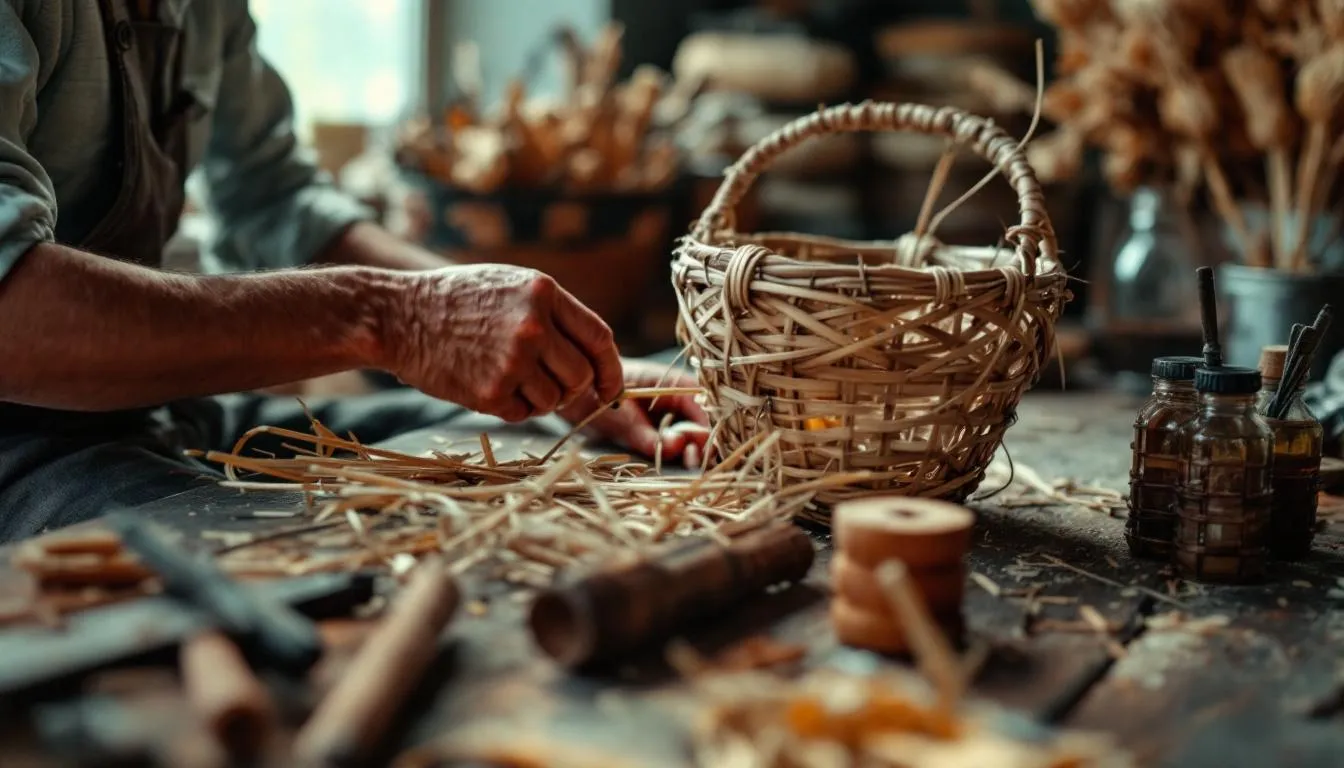
Table of Contents
What Is Basket Weaving?
Basket weaving (also called basketry) is the craft of creating containers and structures by interlacing flexible materials — typically plant fibers like willow, reed, bamboo, or grass. It’s one of the oldest crafts in human history, predating pottery and possibly even weaving cloth.
Older Than Almost Everything
Humans have been weaving baskets for at least 10,000 years, and probably much longer. The problem with dating basketry is that organic materials decompose — unlike pottery or stone tools, baskets rarely survive in the archaeological record. The oldest known intact baskets, found in Danger Cave, Utah, are roughly 10,000 years old. But impressions of woven patterns in clay fragments suggest the craft goes back further still.
Before pottery, before metal containers, before plastic — baskets were how humans carried, stored, and transported virtually everything. Food, water (when lined with pitch or clay), clothing, babies, trade goods. The craft was universal: every culture on every continent developed its own basketry traditions using whatever plant materials were locally available.
How It’s Done
There are three fundamental basket-weaving techniques, and nearly every basket in the world uses one of them or a combination.
Coiling
A foundation material (a bundle of grass, pine needles, or a single thick rod) is wrapped in a spiral, with each coil stitched to the previous one using a thinner, flexible material. Coiled baskets are common in African, Native American, and Middle Eastern traditions. The stitching pattern creates the visual design — skilled coilers produce complex geometric patterns through color and stitch variation.
Plaiting
Flat strips of material (palm leaves, bark, split bamboo) are woven over and under each other in a grid pattern, similar to weaving cloth. Plaiting is the simplest technique conceptually and produces flat or gently curved forms. It’s the basis for mats, hats, and many utilitarian baskets throughout Southeast Asia and the Pacific Islands.
Wicker (Stake-and-Strand)
A framework of rigid stakes (typically willow rods) forms the skeleton, and more flexible weavers are woven in and out between the stakes. This is the technique most Westerners picture when they think of basket weaving — the classic round, ribbed basket. It produces strong, dimensional forms suitable for everything from laundry hampers to fishing creels.
Cultural Traditions
Native American Basketry
Indigenous peoples of North America developed some of the world’s most sophisticated basketry traditions. Pomo baskets from California, woven so tightly they could hold water, were decorated with feathers, shells, and beads. Cherokee double-weave baskets use river cane split to thin strips and dyed with natural pigments. Hopi and Apache basket traditions continue today, though many weavers express concern about the declining availability of traditional gathering sites.
Gullah sweetgrass baskets from the Lowcountry of South Carolina represent a living connection to West African coiled basketry traditions brought by enslaved people. These baskets, sold along roadsides near Charleston, are both functional art and cultural heritage — the technique has been passed down through families for over 300 years.
Japanese Bamboo Art
Japanese bamboo basketry (take zaiku) reached extraordinary artistic heights. Some pieces are displayed in major art museums worldwide, valued as sculpture rather than craft. The distinction between “craft” and “art” in Japanese bamboo work was formally recognized when master weavers were designated Living National Treasures.
European Willow Baskets
Willow basketry has been practiced in Europe since at least the Bronze Age. The English village of Stoke Gregory in Somerset remains a center of willow growing and weaving. Traditional forms — shopping baskets, lobster pots, bee skeps, wattle fencing — were essential to rural life until mass production made them obsolete for everyday use.
The Materials Matter
The choice of material defines a basket’s character. Willow is strong, flexible when fresh, and holds its shape beautifully when dry. Rattan (from tropical palms) is the material in most commercially produced wicker furniture. Bamboo is incredibly strong for its weight and splits cleanly into uniform strips. Sweetgrass produces fine, coiled baskets with a distinctive sweet fragrance. Pine needles create delicate coiled vessels with a warm, amber color.
Gathering and preparing materials is often as time-consuming as the weaving itself. Willow rods must be harvested in winter, dried, and then soaked before use. Ash splints are created by pounding a log until growth rings separate — a process that produces the thin, flexible strips used in Northeastern Native American basketry. Botany knowledge helps weavers identify the right species, harvest sustainably, and understand how moisture, season, and growth conditions affect material quality.
Why Basket Weaving Persists
In a world of plastic bins and cardboard boxes, handmade baskets might seem like a relic. They’re not. The craft has experienced steady revival interest, driven by several factors.
Sustainability — Baskets are made from renewable, biodegradable materials. With plastic waste concern, objects that return to the earth after use have renewed appeal.
Meditation and mindfulness — The repetitive, rhythmic nature of weaving is genuinely calming. Many contemporary weavers describe the craft as a form of moving meditation, similar to knitting or pottery.
Cultural preservation — Communities worldwide are working to keep basketry traditions alive, recognizing them as carriers of cultural knowledge, history, and identity.
Art — Contemporary basket artists push the form in directions that ancestral weavers might not recognize but would probably appreciate: sculptural installations, mixed-media pieces, architectural-scale works that blur the line between craft and fine art.
The internet joke about “underwater basket weaving” as the archetypal useless class has done the craft a disservice. Basket weaving is one of humanity’s most ancient and universal technologies. It requires genuine skill, botanical knowledge, physical dexterity, and aesthetic judgment. And when you finish a basket, you have something beautiful, functional, and made entirely by hand from materials that grew from the ground. Not bad for a “useless” hobby.
Frequently Asked Questions
How old is basket weaving?
Basket weaving is one of the oldest human crafts, with evidence dating back at least 10,000-12,000 years. Impressions of woven baskets have been found in clay dating to 8000 BCE. Actual preserved baskets from Danger Cave in Utah are approximately 10,000 years old. The craft likely predates pottery, which baskets may have inspired.
What materials are used in basket weaving?
Common materials include willow (the most popular in Europe), rattan and bamboo (Asia), sweetgrass and ash splints (Native American traditions), raffia (Africa), and pine needles, reed, and rush. The key requirement is that the material be flexible enough to bend without breaking and strong enough to hold shape when dry.
Can you make money from basket weaving?
Yes, though it's a niche market. Handmade baskets sell from $30 for simple designs to several thousand dollars for fine art pieces. Gullah sweetgrass baskets from South Carolina, Native American baskets, and Japanese bamboo art baskets command premium prices. Teaching workshops is another income stream for skilled weavers.
Further Reading
Cite this article
APA
WhatIs.site. (2025). What Is Basket Weaving?. Retrieved May 27, 2026, from https://whatis.site/basket-weaving MLA
"What Is Basket Weaving?." WhatIs.site, July 15, 2025, https://whatis.site/basket-weaving. Accessed May 27, 2026. Chicago
WhatIs.site. "What Is Basket Weaving?." Last modified May 12, 2026. https://whatis.site/basket-weaving. HTML
<a href="https://whatis.site/basket-weaving">What Is Basket Weaving?</a> — WhatIs.site Related Articles
What Is Anthropology?
Anthropology is the study of humans—past and present—across cultures, biology, language, and societies. Learn its branches, methods, and why it matters.
arts amp cultureWhat Is Art History?
Art history is the scholarly study of visual arts — painting, sculpture, architecture, photography, and other visual forms — examining how they were created.
scienceWhat Is Archaeology?
Archaeology is the study of human history through physical remains like artifacts, buildings, and bones. Learn about methods, famous discoveries, and careers.
scienceWhat Is Botany?
Botany is the scientific study of plants — their structure, physiology, genetics, ecology, distribution, classification, and evolutionary relationships.
scienceWhat Is Natural History?
Natural history is the systematic observation, description, and study of the natural world — animals, plants, fungi, minerals, fossils, weather.