 WhatIs.site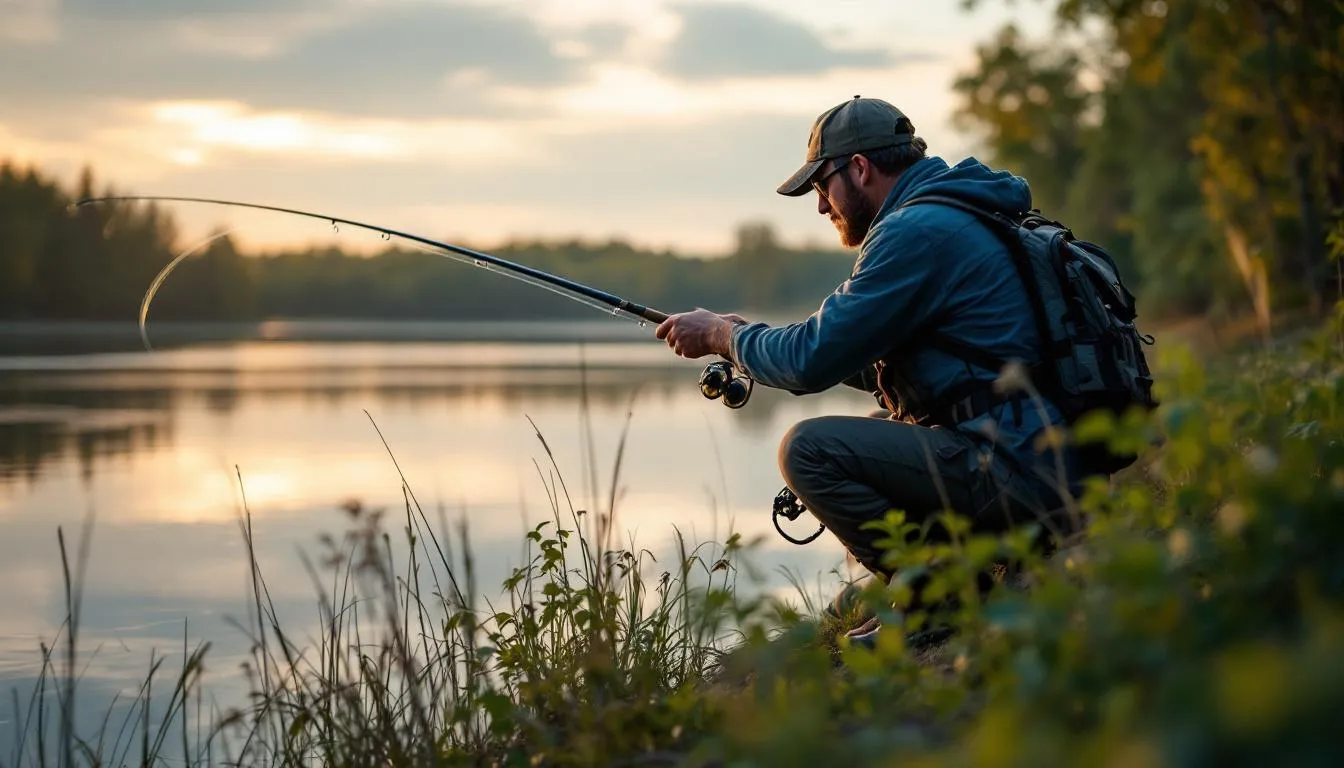
Table of Contents
What Is Fishing?
Fishing is the activity of catching fish and other aquatic organisms, whether for food, recreation, sport, or commercial sale. Humans have been fishing for at least 40,000 years — it’s one of our oldest food-gathering practices. Today, fishing operates on a staggering scale: the global fishing industry harvests roughly 80 million metric tons of wild fish annually, while recreational fishing engages hundreds of millions of people worldwide.
Two Very Different Worlds
Fishing exists in two distinct forms that share a name but differ in almost every other way.
Recreational fishing (angling) is a hobby, sport, and meditative practice for roughly 50 million Americans and hundreds of millions worldwide. It’s about the experience — being outdoors, testing skill against fish, enjoying time on the water. Many recreational anglers practice catch-and-release, returning fish to the water after landing them.
Commercial fishing is an industry that feeds billions. Commercial operations range from individual fishermen working small boats to industrial trawlers processing tons of fish at sea. It’s one of the most physically dangerous occupations in the world — the fatality rate for commercial fishermen is about 40 times the national average for all workers.
Recreational Techniques
The variety of fishing methods is enormous. Each technique suits different species, environments, and angler preferences.
Spin fishing is the most common approach. You cast a lure or bait using a spinning reel, retrieve it through the water, and hope a fish strikes. It’s versatile, relatively easy to learn, and effective for a huge range of species.
Fly fishing uses an artificial fly (made from feathers, fur, and thread tied onto a hook) presented on a nearly weightless line. The casting technique is distinctive — you’re casting the weight of the line itself, not the lure. Fly fishing is associated with trout streams but works for bass, pike, saltwater species, and even carp. The learning curve is steep, but practitioners tend to become obsessive.
Bait fishing uses live or natural bait — worms, minnows, crickets, shrimp — to attract fish. It’s the simplest method and often the most effective. There’s no shame in a worm on a hook; fish don’t care about your technique.
Trolling involves pulling lures or baits behind a moving boat, covering large areas of water. It’s common in both freshwater (for walleye, trout) and saltwater (for tuna, marlin, sailfish).
Ice fishing is exactly what it sounds like — drilling holes through frozen lakes and fishing through the ice. It’s popular in northern states and Canada, and it involves specialized equipment including portable shelters, augers, and tip-up devices that signal when a fish bites.
The Gear
Fishing equipment ranges from a stick with a string (which still works) to $1,000 fly rods and $50,000 offshore boats.
The basic setup is a rod, reel, line, and hook. Rods vary from ultralight (for small stream trout) to heavy-duty surf rods (for casting from beaches) to stout boat rods (for deep-sea species). Reels hold and control the line. Lines come in monofilament, fluorocarbon, and braided varieties, each with different stretch, visibility, and strength characteristics.
Terminal tackle — the stuff at the end of your line — includes hooks, weights (sinkers), bobbers (floats), swivels, leaders, and lures. Lure variety is absurd. Crankbaits, spinnerbaits, jigs, soft plastics, spoons, topwater plugs — each mimics a different food source or triggers a different predatory response. Lure shopping can become its own hobby.
Commercial Fishing
The commercial fishing industry is massive and complex. Major methods include:
Trawling drags large nets through the water, capturing everything in their path. Bottom trawling — dragging nets across the seafloor — is effective but environmentally destructive, damaging ocean floor habitats.
Longlining sets lines stretching miles with thousands of baited hooks. It’s used for tuna, swordfish, and halibut but catches unintended species (bycatch) including sea turtles, sharks, and seabirds.
Purse seining encircles schools of fish (often tuna or sardines) with a large net that closes at the bottom like a drawstring purse. It’s efficient but can capture dolphins and other marine mammals along with target species.
Aquaculture (fish farming)) has grown dramatically. About half of all fish consumed globally now comes from aquaculture rather than wild catch. Farmed species include salmon, tilapia, shrimp, catfish, and carp. Aquaculture reduces pressure on wild stocks but raises its own environmental concerns — water pollution, disease transmission to wild fish, and habitat destruction for coastal shrimp farms.
The Sustainability Problem
The ocean isn’t infinite, and we’ve been treating it like it is. About 35% of global fish stocks are currently overfished, according to the FAO. Some formerly abundant species have been fished to near-collapse.
The Atlantic cod fishery off Newfoundland was one of the world’s richest for 500 years. Industrial trawlers depleted it so severely that the Canadian government imposed a total fishing moratorium in 1992. Thirty years later, the stock still hasn’t fully recovered. Forty thousand people lost their livelihoods overnight.
Sustainable fishing management involves setting science-based catch limits, enforcing regulations, reducing bycatch, protecting spawning areas, and combating illegal fishing (which accounts for an estimated 20% of global catch). Progress is uneven — some fisheries are well-managed, while others face minimal oversight.
Why People Fish
Recreational anglers fish for reasons that go beyond catching dinner. Surveys consistently show that the top motivations are being outdoors, relaxation, spending time with friends and family, and the challenge of catching fish — with actually catching fish ranking surprisingly low on the list.
There’s something about the combination of patience, skill, natural surroundings, and uncertainty that makes fishing deeply satisfying. You can’t control whether a fish bites. You can only put yourself in the right place, with the right presentation, and wait. In a world designed around instant gratification, that forced patience is either maddening or therapeutic. Usually both.
Frequently Asked Questions
How many people fish in the United States?
About 50 million Americans go fishing at least once per year, making it one of the most popular outdoor recreational activities in the country. Anglers spend approximately $50 billion annually on trips, equipment, and licenses. Fishing license fees fund a significant portion of state wildlife conservation programs.
What is the difference between freshwater and saltwater fishing?
Freshwater fishing takes place in lakes, rivers, ponds, and streams, targeting species like bass, trout, catfish, and walleye. Saltwater fishing occurs in oceans and coastal waters, targeting species like tuna, redfish, tarpon, and marlin. The equipment, techniques, and regulations differ significantly between the two.
Is overfishing a serious problem?
Yes. The FAO estimates that about 35% of global fish stocks are overfished — harvested at biologically unsustainable levels. Some populations have collapsed entirely, like Atlantic cod off Newfoundland, which crashed in the early 1990s and still hasn't fully recovered. Sustainable fishing practices and better management are critical to maintaining fish populations.
Further Reading
Cite this article
APA
WhatIs.site. (2025). What Is Fishing?. Retrieved May 27, 2026, from https://whatis.site/fishing MLA
"What Is Fishing?." WhatIs.site, July 15, 2025, https://whatis.site/fishing. Accessed May 27, 2026. Chicago
WhatIs.site. "What Is Fishing?." Last modified May 12, 2026. https://whatis.site/fishing. HTML
<a href="https://whatis.site/fishing">What Is Fishing?</a> — WhatIs.site Related Articles
What Is Foraging?
Foraging is the practice of gathering wild food from natural environments — plants, mushrooms, fruits, nuts, seaweed, and occasionally insects or shellfish.
everyday conceptsWhat Is Gardening?
Gardening is the practice of growing and tending plants — flowers, vegetables, herbs, fruits, shrubs, and trees — in a defined space for food, beauty.
scienceWhat Is Limnology?
Limnology is the scientific study of inland waters—lakes, ponds, rivers, streams, wetlands, and reservoirs.
sportsWhat Is Pontoon Boating?
A pontoon boat is a flat-decked watercraft supported by two or three aluminum tubes (pontoons) that keep it floating.