 WhatIs.site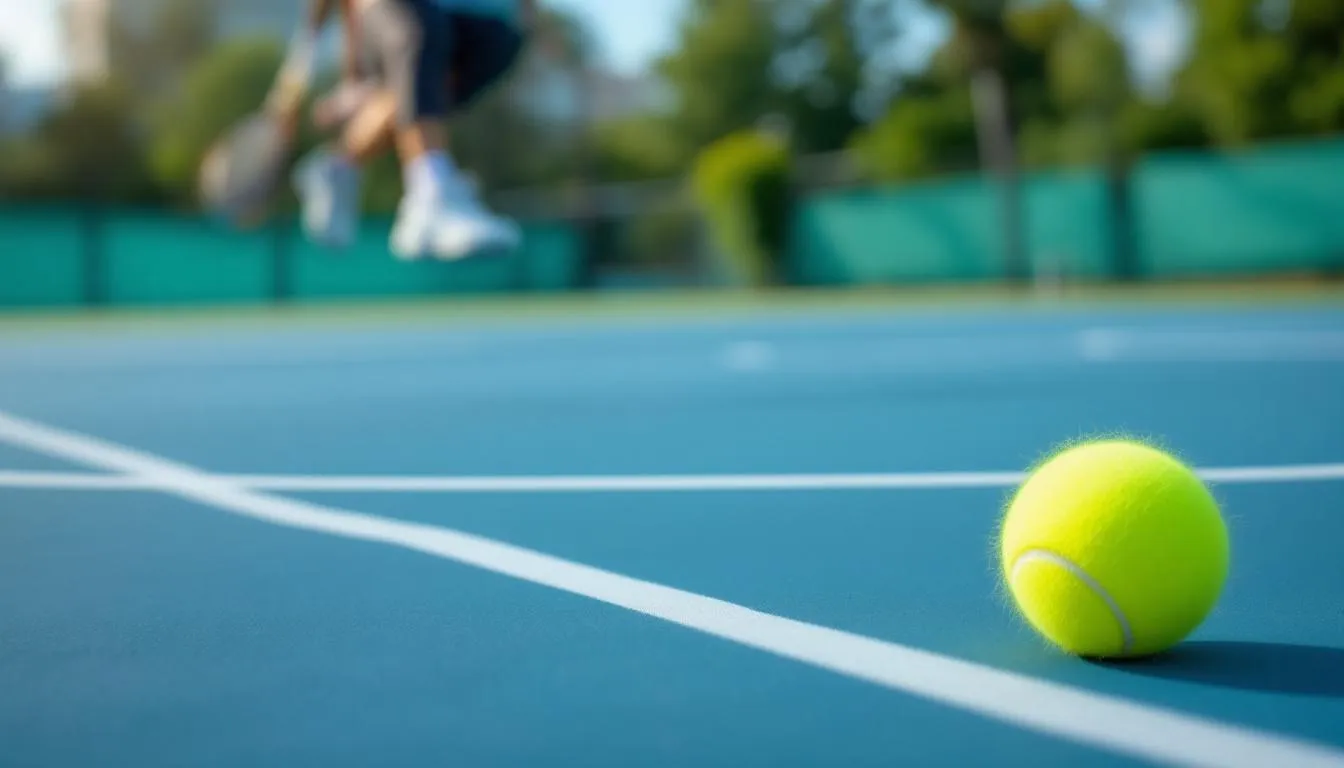
Table of Contents
What Is Tennis?
Tennis is a racket sport played on a rectangular court where players (singles) or pairs (doubles) hit a felt-covered rubber ball over a net using string-rackets. The objective is to hit the ball into the opponent’s side of the court in such a way that they can’t return it successfully.
It’s one of the most popular individual sports in the world — played by an estimated 87 million people in over 200 countries. And unlike most sports, tennis produces genuinely gripping drama through a scoring system that means no lead is ever truly safe.
The Scoring (Yes, It’s Confusing)
Tennis uses a nested scoring structure: points make up games, games make up sets, and sets make up matches.
Points within a game go: 0 (called “love”), 15, 30, 40, game. You need to win by 2 points. When the score reaches 40-40 (“deuce”), a player must win two consecutive points — “advantage” (one point ahead) and then the game point.
Games make up sets. The first player to win 6 games wins the set, provided they lead by at least 2 games. If it’s 6-6, most tournaments play a tiebreak (first to 7 points, win by 2).
Matches are typically best-of-3 sets (women’s Grand Slams and most men’s tournaments) or best-of-5 sets (men’s Grand Slams).
This structure creates a sport where momentum shifts are constant. You can lose more total points than your opponent and still win the match. A player can be down 1-5 in a set and still come back. The drama is structural.
The Court
A standard tennis court is 78 feet long and 27 feet wide for singles (36 feet for doubles). The net is 3 feet high at the center. Courts come in three main surface types:
- Hard court — Acrylic or concrete. The most common surface worldwide. Medium-fast speed. Used at the Australian Open and US Open.
- Clay — Crushed brick or stone. Slow, high-bouncing surface that favors patient, defensive players. Used at the French Open.
- Grass — Fast, low-bouncing surface that favors serve-and-volley play. Used at Wimbledon. Increasingly rare elsewhere.
Surface affects everything — ball speed, bounce height, movement, and playing strategy. A player who dominates on clay may struggle on grass, and vice versa.
The Strokes
Serve — The starting shot of every point. The server tosses the ball and hits it overhead into the diagonally opposite service box. A powerful serve (top professionals hit 130+ mph) is one of the biggest advantages in the sport.
Forehand — A groundstroke hit on the dominant-hand side. Generally the most powerful shot for most players.
Backhand — Hit on the non-dominant side, either one-handed or two-handed. Historically considered a weakness; modern players have developed backhands that rival their forehands.
Volley — A shot hit before the ball bounces, usually near the net. Requires quick reflexes and soft hands.
Overhead/Smash — A powerful overhead shot, typically hit to put away a high, short ball.
The Grand Slams
The four Grand Slam tournaments are the biggest events in tennis:
- Australian Open — Melbourne, January. Hard court. Known for extreme heat.
- French Open (Roland-Garros) — Paris, May-June. Clay court. The most physically demanding.
- Wimbledon — London, June-July. Grass court. The oldest and most prestigious tournament (since 1877). White clothing is mandatory.
- US Open — New York, August-September. Hard court. The loudest and most boisterous Grand Slam.
Winning all four in a calendar year is a “Grand Slam” — achieved in men’s singles by only Don Budge (1938) and Rod Laver (1962, 1969), and in women’s singles by Maureen Connolly (1953), Margaret Court (1970), and Steffi Graf (1988).
The Modern Game
Tennis has been shaped by extraordinary rivalries. The “Big Three” — Roger Federer, Rafael Nadal, and Novak Djokovic — dominated men’s tennis for nearly two decades, combining for 66 Grand Slam singles titles. Their contrasting styles (Federer’s grace, Nadal’s intensity, Djokovic’s adaptability) produced some of the greatest matches in sports history.
Women’s tennis has produced equally compelling champions. Serena Williams’s 23 Grand Slam singles titles (the Open Era record) rewrote what was possible. Her power, athleticism, and mental toughness raised the level of the entire women’s game.
Health Benefits
Tennis is excellent exercise). A competitive singles match burns 400-600 calories per hour and involves sprinting, lateral movement, coordination, and endurance. A 2018 study in the British Journal of Sports Medicine found that tennis players had a 47% lower risk of all-cause mortality compared to sedentary individuals — the highest reduction of any sport studied.
The sport is also highly social. Doubles play is inherently collaborative, and the tennis club culture provides community and connection.
Getting Started
All you need is a racket, balls, and access to a court (many public parks have free courts). Lessons help enormously — self-taught players typically develop bad habits that limit their progress. Most tennis clubs and recreation departments offer beginner group lessons at reasonable prices. The learning curve is real, but the reward of a well-struck ball and a hard-fought match is addictive.
Frequently Asked Questions
Why does tennis use such a weird scoring system?
Tennis scoring (15, 30, 40, game) likely originated in medieval France, possibly based on the face of a clock (quarters: 15, 30, 45 — with 45 shortened to 40 for practical reasons). Nobody is completely sure. The system has survived because it creates natural drama — you must win by 2 points, and the 'deuce' system means games can extend indefinitely.
What are the four Grand Slam tournaments?
The Australian Open (January, hard court), the French Open/Roland-Garros (May-June, clay court), Wimbledon (June-July, grass court), and the US Open (August-September, hard court). Winning all four in a calendar year is called a Grand Slam — accomplished by only 5 players in singles history.
Is tennis hard to learn?
The basics — hitting the ball back and forth — can be picked up in a few lessons. But tennis has a steep learning curve for intermediate skills. Developing consistent groundstrokes, learning to serve, and building tactical awareness takes months to years. The good news: you don't need to be good to have fun. A rally between two beginners is still enjoyable exercise.
Further Reading
Cite this article
APA
WhatIs.site. (2025). What Is Tennis?. Retrieved May 27, 2026, from https://whatis.site/tennis MLA
"What Is Tennis?." WhatIs.site, July 15, 2025, https://whatis.site/tennis. Accessed May 27, 2026. Chicago
WhatIs.site. "What Is Tennis?." Last modified May 12, 2026. https://whatis.site/tennis. HTML
<a href="https://whatis.site/tennis">What Is Tennis?</a> — WhatIs.site Related Articles
What Is Table Tennis?
Table tennis (ping-pong) is a fast-paced racket sport played on a table with a small ball. Learn the rules, techniques, and why it's so popular worldwide.
scienceWhat Is Sports Science?
Sports science applies biology, physics, and psychology to improve athletic performance, prevent injuries, and optimize training. Here's how it works.
health amp wellnessWhat Is Exercise Physiology?
Exercise physiology studies how your body responds and adapts to physical activity, covering energy systems, muscle function, and training principles.
historyWhat Is Sports History?
Sports history is the study of how organized physical competition developed across human civilizations.
health amp wellnessWhat Is Sports Psychology?
Sports psychology studies mental factors that affect athletic performance. Learn about visualization, focus, anxiety management, and peak performance.