 WhatIs.site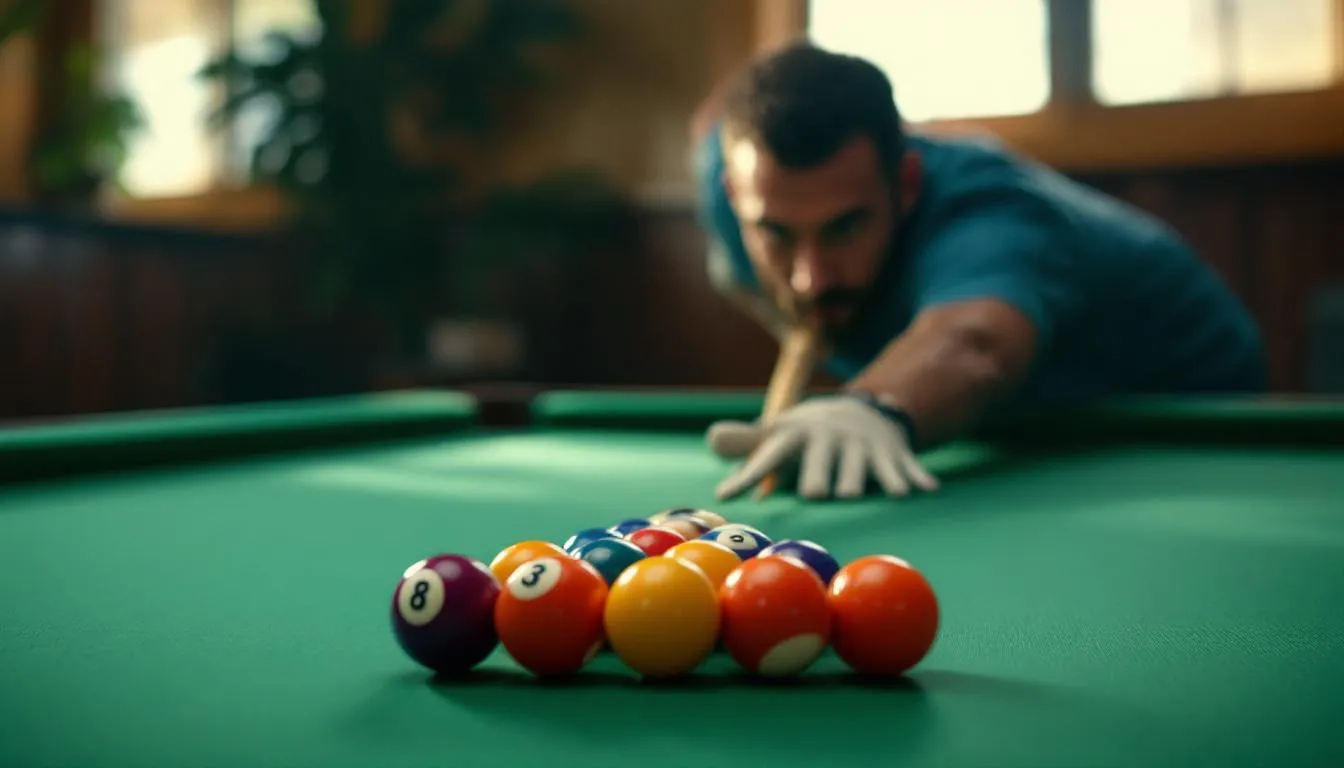
Table of Contents
What Is Pool (Billiards)?
Pool — more formally called pocket billiards — is a cue sport played on a rectangular, felt-covered table with six pockets. Players use a stick called a cue to strike a white cue ball, which then hits numbered object balls into the pockets. It’s a game of geometry, physics, touch, and nerves, played everywhere from basement rec rooms to professional tournaments watched by millions.
The Table and Equipment
A standard American pool table is either 7 feet (bar size), 8 feet (home size), or 9 feet (tournament size). The playing surface is typically slate — a flat stone slab ground to within thousandths of an inch of level — covered with a woven cloth historically called “felt” (though modern cloth is usually a wool-nylon blend).
Six pockets — four corner pockets and two side pockets — are cut into the cushioned rails. Corner pockets are slightly larger than side pockets and accept balls at sharper angles.
The balls are 2.25 inches in diameter, made from phenolic resin (a hard, dense plastic). The standard set includes a white cue ball and 15 numbered object balls: 1-7 are solid colors, 9-15 are striped, and the 8-ball is solid black.
The cue stick is typically 57-59 inches long, made from maple or other hardwoods, weighing 18-21 ounces. The tip — usually made of layered leather — is the only part that contacts the cue ball. How and where you strike the cue ball with that tip determines everything that happens next.
The Major Games
Eight-ball is what most people think of as “pool.” Two players (or teams) compete. After the break, the first player to legally pocket a ball claims that group — solids (1-7) or stripes (9-15). Each player then works to pocket all their balls, then legally pocket the 8-ball to win. Pocketing the 8-ball early, or scratching (pocketing the cue ball) while shooting the 8-ball, loses the game. Eight-ball accounts for probably 80% of all pool played worldwide.
Nine-ball is the standard professional format. Only balls 1 through 9 are used. Players must contact the lowest-numbered ball on the table first, but can pocket any ball on any shot. The player who pockets the 9-ball wins — whether through running all nine balls in order or by a lucky combination shot. The element of luck makes nine-ball exciting to watch but somewhat controversial among purists.
Straight pool (14.1 continuous) is the traditional test of skill. Players score one point per ball pocketed and play to a predetermined total (usually 150 in professional play). When 14 balls are pocketed, they’re re-racked while the cue ball and the 15th ball remain in play, and the shooting continues without interruption. Willie Mosconi set the record with a run of 526 consecutive balls in 1954.
Snooker deserves mention even though it’s technically a different game. Played on a much larger table (12 feet) with 22 balls, snooker requires extraordinary precision and is hugely popular in the UK, China, and Commonwealth countries. The top snooker players — Ronnie O’Sullivan, Stephen Hendry — are some of the most skilled athletes in any cue sport.
The Physics Are Real
Pool is applied physics. Every shot involves:
Angle of incidence equals angle of reflection — when the cue ball hits an object ball, it deflects at a predictable angle. For a full hit (dead center), the cue ball stops and the object ball moves along the line of the cue ball’s original path. For a half-ball hit, both balls move at roughly 30 degrees from the original line. Learning these angles is the foundation of aiming.
Spin (English) — striking the cue ball off-center imparts spin. Top spin (follow) makes the cue ball continue forward after contact. Bottom spin (draw) makes it come back toward you. Side spin (left or right English) affects how the cue ball bounces off cushions and, slightly, how it interacts with object balls. Advanced players use spin to control cue ball position three or four shots ahead.
Speed control — arguably the most important skill. You need the object ball to reach the pocket, but you also need the cue ball to end up in position for your next shot. Hitting too hard gives you less control over position. Too soft and you leave a difficult angle. Great players make the cue ball go exactly where they want it, rolling to a stop within inches of the planned position.
Cushion play — balls bounce off cushions at angles modified by spin and speed. Rail shots, kick shots (hitting cushions before contacting the object ball), and bank shots (object balls bouncing off cushions into pockets) add complexity. Some of the most impressive shots in professional pool involve three or four cushion contacts.
A Quick History
Billiards started as an outdoor lawn game — similar to croquet — in 15th-century France. It moved indoors onto wooden tables with green cloth (mimicking grass) sometime in the 1400s-1500s. The cue stick replaced the mace (a blunt-ended stick used to push balls) around 1800.
The game spread through Europe and became associated with aristocracy. Mary, Queen of Scots, was reportedly a player. Louis XIV had a billiard table at Versailles. The game crossed the Atlantic with European colonists.
In America, pool evolved through the 19th century in saloons and pool halls. The association with gambling and rougher crowds gave pool a seedy reputation that persisted for decades. The 1961 movie The Hustler, starring Paul Newman, both reinforced and romanticized this image.
The professional game peaked in the mid-20th century, declined, then surged again in the 1990s when ESPN began televising professional pool. The rise of pool in Asia — particularly the Philippines and China — has globalized the sport. China now has an estimated 75 million regular pool players.
Why It Endures
Pool is one of those rare activities where a complete beginner and a skilled player can enjoy the same game. Your first night at a bar table, you’re laughing at missed shots and celebrating lucky ones. A decade in, you’re planning three shots ahead and cursing yourself for being a quarter-inch off position.
The game rewards patience, practice, and the ability to think geometrically. It punishes sloppiness and emotional reactions. One bad shot — one moment of frustration or overconfidence — can cost you a game you were winning.
And it happens in a social setting. Pool tables exist in bars, game rooms, community centers, and basements specifically because the game is social. You’re standing, moving, talking. You’re watching your opponent and reading the table. It’s competitive without being exhausting. That combination — mental challenge plus social atmosphere — is why pool tables have been in bars for over a century and show no signs of leaving.
Frequently Asked Questions
What is the difference between pool, billiards, and snooker?
Pool (pocket billiards) is played on a 7-9 foot table with 6 pockets and 15 numbered balls plus a cue ball. Billiards (carom billiards) is played on a pocketless table with only 3 balls, scoring by bouncing the cue ball off two other balls. Snooker is played on a larger 12-foot table with 6 pockets, using 21 colored balls and 15 red balls. Each is a distinct game with different rules, equipment, and skills.
What are the most common pool games?
Eight-ball is the most widely played — two players claim stripes or solids and race to pocket their group, then the 8-ball. Nine-ball uses only balls 1-9, played in numerical order, and the player who legally pockets the 9-ball wins. Straight pool (14.1 continuous) counts total balls pocketed to a target score, usually 150. Ten-ball is gaining popularity as a professional format because it requires called shots.
Why is it called 'pool'?
The name comes from 'pool rooms' — betting parlors in 19th-century America where patrons pooled their money for horse racing wagers. These establishments often had billiard tables for entertainment while waiting for race results. The game became so associated with these venues that the name stuck, even though the game itself has nothing to do with pooling money.
Further Reading
Cite this article
APA
WhatIs.site. (2025). What Is Pool (Billiards)?. Retrieved May 27, 2026, from https://whatis.site/pool-billiards MLA
"What Is Pool (Billiards)?." WhatIs.site, July 15, 2025, https://whatis.site/pool-billiards. Accessed May 27, 2026. Chicago
WhatIs.site. "What Is Pool (Billiards)?." Last modified May 12, 2026. https://whatis.site/pool-billiards. HTML
<a href="https://whatis.site/pool-billiards">What Is Pool (Billiards)?</a> — WhatIs.site Related Articles
What Is Physics?
Physics is the science of matter, energy, and the fundamental forces governing the universe. Learn how physics explains everything from atoms to galaxies.
scienceWhat Is Geometry?
Geometry is the branch of mathematics studying shapes, sizes, positions, and spatial relationships. Learn about Euclidean, non-Euclidean, and modern geometry.
everyday conceptsWhat Is Game Theory?
Game theory is the mathematical study of strategic decision-making between rational agents. Learn about Nash equilibrium, the prisoner's dilemma, and more.