 WhatIs.site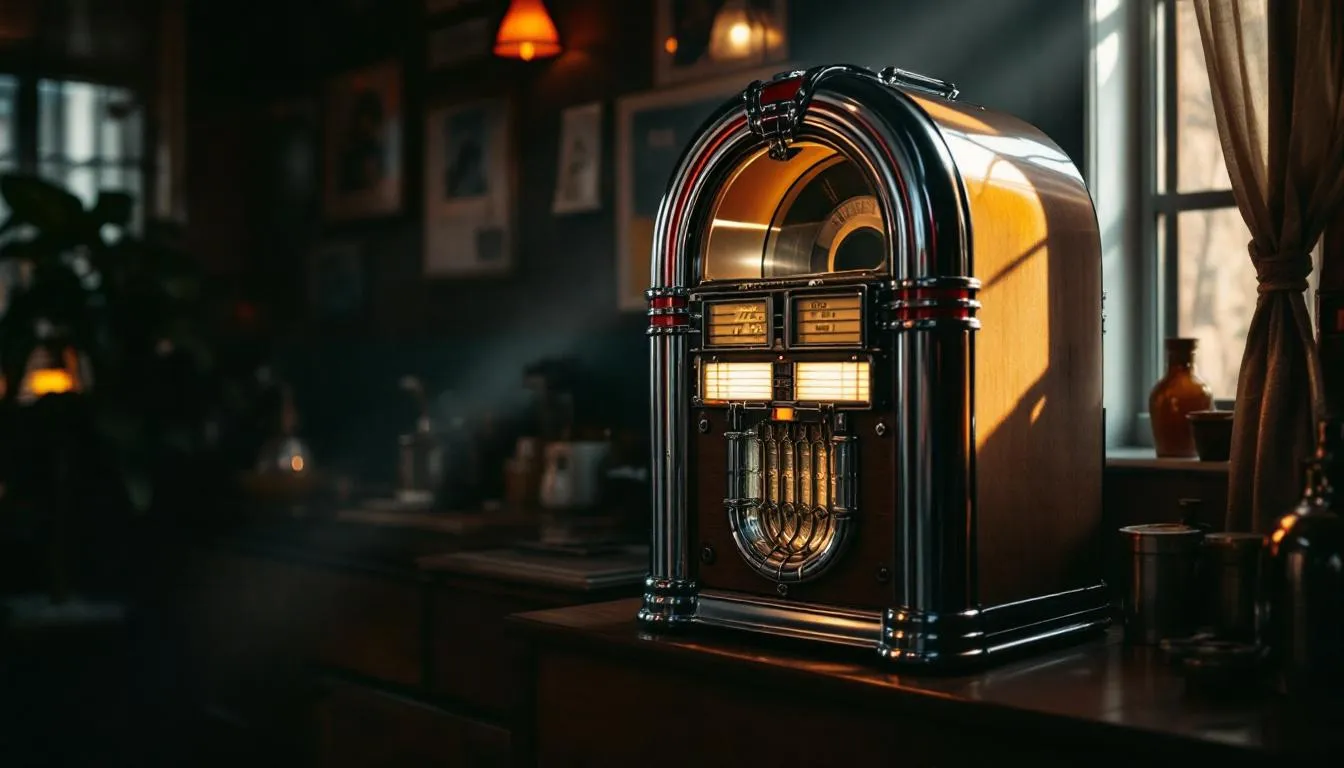
Table of Contents
What Is Jukebox Collecting?
Jukebox collecting is the hobby of finding, buying, restoring, and displaying coin-operated music machines — primarily the colorful, chrome-laden models from the 1940s through 1970s that were once fixtures in diners, bars, and soda fountains across America. These machines are equal parts musical instrument, mechanical marvel, and design icon, and they attract collectors who appreciate the intersection of music, engineering, and visual art.
The Golden Age
The jukebox’s golden age ran from the late 1930s through the 1960s. During this period, jukeboxes were the primary way most Americans heard recorded music in public. At their peak in 1946, an estimated 750,000 jukeboxes operated across the United States — in diners, bars, restaurants, bus stations, and drugstores.
The major manufacturers competed fiercely on design:
Wurlitzer produced the most collectible models. The 1946 Model 1015 — nicknamed the “Bubbler” for its illuminated, rising-bubble tubes — is the most iconic jukebox ever made. About 56,000 were produced. A fully restored 1015 commands $15,000 to $50,000 today.
Seeburg pioneered the 45 RPM jukebox in 1950 (previously, jukeboxes played 78 RPM records) and introduced the first 100-selection model. Seeburg machines from the 1950s have a sleek, space-age aesthetic that appeals to mid-century modern enthusiasts.
Rock-Ola and AMI produced excellent machines that are generally more affordable than Wurlitzer and Seeburg equivalents, making them good entry points for new collectors.
What Makes a Jukebox Work
A jukebox is a remarkably complex machine. When you drop a coin and press a selection:
- A selector mechanism registers your choice
- A mechanical arm retrieves the correct record from a magazine holding 20 to 200 discs
- The record is placed on a turntable and the tone arm lowered
- An amplifier drives speakers built into the cabinet
- After the song plays, the mechanism returns the record and waits for the next selection
All of this happens through a combination of cams, gears, solenoids, relays, and (in later models) solid-state electronics. The mechanical precision required is impressive — early jukeboxes had no electronics at all, using purely mechanical logic to select and play records.
Getting Started Collecting
Budget. Common 1970s-80s models start around $500-1,500 and are the most practical starting point. Classic 1950s models in playing condition run $2,000-8,000. Premium 1940s Wurlitzers command $10,000-50,000.
Space. A full-size jukebox is roughly 5 feet tall, 3 feet wide, and weighs 250-400 pounds. You need floor space and a way to get it into your home (moving companies with experience handling heavy items are recommended).
Power. Most vintage jukeboxes run on standard household current, though some need outlet adapters and all should be inspected for electrical safety before use.
Records. You need 45 RPM singles to fill it. Thrift stores, record shops, and online sellers offer endless supply at $0.50-5.00 per disc. Part of the fun is curating your own playlist from physical media.
Restoration
Most vintage jukeboxes need some degree of restoration. The process involves:
Mechanical restoration — cleaning, lubricating, and adjusting the record-changing mechanism. Worn parts may need replacement or fabrication. This is the most critical step — a jukebox that does not play records is just furniture.
Electrical restoration — replacing degraded wiring, capacitors, and tubes (or converting to solid-state amplification). Safety is the priority — old wiring can be a fire hazard.
Cabinet restoration — refinishing wood, replating chrome, repainting colored panels, and replacing broken plastic or glass components. Original parts in good condition are valuable; reproduction parts are available for popular models.
Lighting — replacing fluorescent tubes, neon, and bubble mechanisms that give vintage jukeboxes their distinctive glow.
Professional restoration costs $2,000-10,000 depending on the model and condition. DIY restoration is possible for mechanically inclined collectors willing to learn — the community shares knowledge generously through forums, YouTube channels, and local collector groups.
The Community
Jukebox collectors tend to be passionate and welcoming. The hobby overlaps with music collecting, vintage automobile culture, mid-century modern design appreciation, and mechanical tinkering. Annual shows and swap meets (like the Chicagoland Antique Amusement, Slot Machine, and Jukebox Show) bring collectors together.
The machines themselves have a unique charm that photographs cannot fully capture. The warmth of tube amplification, the mechanical clunk of the selector, the rising bubbles of a Wurlitzer 1015, and the ritual of dropping a coin and hearing a song begin — these physical, sensory experiences are what digital playlists cannot replicate. In a world of streaming music, a jukebox is a deliberate, analog, and thoroughly satisfying way to listen.
Frequently Asked Questions
How much is a vintage jukebox worth?
Values range from $500 for a common 1970s-80s model to $50,000+ for a fully restored 1940s Wurlitzer. The most valuable are 1940s Wurlitzer models (especially the 1015 'Bubbler'), 1950s Seeburg models, and any Rock-Ola or AMI units in excellent original condition. Condition, rarity, and whether it plays properly are the biggest factors.
Are jukeboxes hard to restore?
Yes — they combine mechanical, electrical, and sometimes electronic systems. A typical restoration involves rebuilding the record-changing mechanism, rewiring electrical components, restoring the cabinet (wood repair, chrome replating, repainting), replacing light tubes, and ensuring the amplifier and speakers produce good sound. Budget $2,000-10,000 for a professional restoration.
Can you still buy records for vintage jukeboxes?
Yes. Vintage jukeboxes play 45 RPM singles, which are still manufactured and widely available at record stores, online retailers, and thrift shops. Original 45s from the 1950s-1980s are abundant and inexpensive. Some collectors also use modern pressings. The key is matching the record format to the jukebox — most play 7-inch 45s, though some older models play 78s.
Further Reading
Cite this article
APA
WhatIs.site. (2025). What Is Jukebox Collecting?. Retrieved May 27, 2026, from https://whatis.site/jukebox-collecting MLA
"What Is Jukebox Collecting?." WhatIs.site, July 15, 2025, https://whatis.site/jukebox-collecting. Accessed May 27, 2026. Chicago
WhatIs.site. "What Is Jukebox Collecting?." Last modified May 12, 2026. https://whatis.site/jukebox-collecting. HTML
<a href="https://whatis.site/jukebox-collecting">What Is Jukebox Collecting?</a> — WhatIs.site Related Articles
What Is Jazz Music?
Jazz is an American music genre born in New Orleans, built on improvisation, swing, and blues roots. Learn about its history, styles, and greatest artists.
everyday conceptsWhat Is Hobby Machining?
Hobby machining is using lathes, mills, and other machine tools at home to shape metal and other materials. Learn about equipment, skills, and projects.
everyday conceptsWhat Is Home Brewing?
Home brewing is the practice of making beer, wine, cider, or mead at home, using equipment that fits in a kitchen or garage and ingredients you can order.
everyday conceptsWhat Is K'nex?
K'nex is a construction toy system built around a simple but clever idea: rods of different lengths snap into connectors at fixed angles.