 WhatIs.site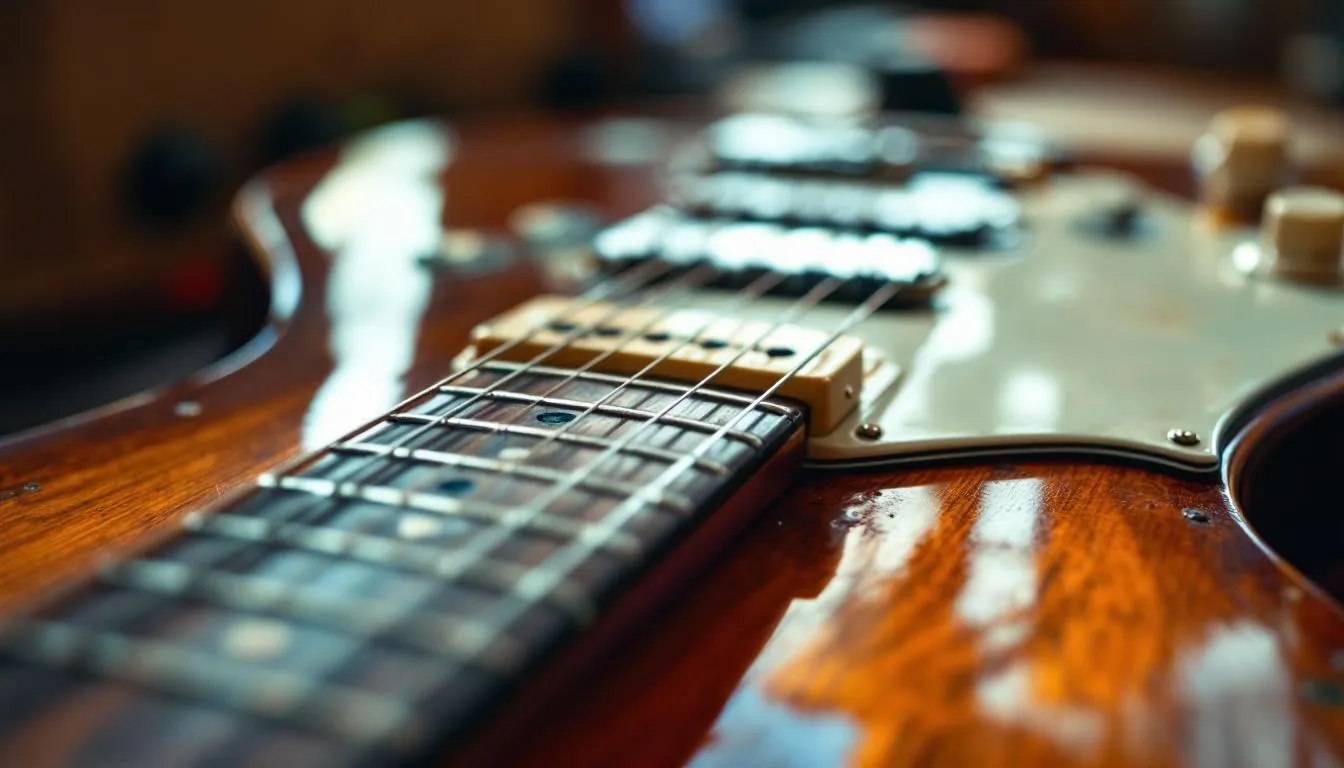
Table of Contents
What Is a Guitar?
A guitar is a stringed musical instrument, typically with six strings, played by strumming or plucking with the right hand while pressing strings against frets on the neck with the left hand. It’s the most popular instrument in the world — an estimated 50 million Americans play guitar, and it dominates popular music across virtually every genre. Rock, blues, country, folk, jazz, classical, pop, metal, funk, bossa nova, flamenco — the guitar shows up everywhere because it’s portable, affordable, versatile enough to play melody, harmony, and rhythm simultaneously, and — this matters — it looks cool.
How It Works
A guitar produces sound through vibrating strings. When you pluck or strum a string, it vibrates at a specific frequency determined by three factors: length (shorter strings vibrate faster = higher pitch), tension (tighter strings vibrate faster = higher pitch), and mass (thicker strings vibrate slower = lower pitch).
On an acoustic guitar, the strings’ vibrations transfer through the saddle and bridge to the guitar’s soundboard (the top), which vibrates and pushes air inside the body. The hollow body acts as a resonating chamber, amplifying the sound and projecting it through the sound hole.
On an electric guitar, the strings vibrate over magnetic pickups — magnets wrapped with fine copper wire that convert the strings’ motion into an electrical signal. That signal travels through a cable to an amplifier, which boosts it and sends it to a speaker. The electric guitar’s solid body doesn’t amplify sound acoustically — unplugged, it’s barely audible.
Frets — thin metal strips embedded in the neck — determine pitch. Pressing a string down behind a fret shortens its vibrating length, raising the pitch by precise intervals. Standard guitar tuning (E-A-D-G-B-E from lowest to highest string) gives the instrument a range of about four octaves.
Acoustic Guitars
Steel-string acoustics are the most common type in North America. The steel strings produce a bright, loud, ringing tone suitable for strumming chords and fingerpicking. Body shapes affect sound — dreadnoughts (large bodies) produce booming volume and bass, while smaller concert and parlor guitars have a more focused, balanced tone.
Classical (nylon-string) guitars use nylon strings (historically gut), producing a warmer, softer tone. The neck is wider, the body shape standardized. Classical guitar technique uses fingernails rather than picks. This is the guitar of flamenco, classical repertoire, and bossa nova.
Twelve-string guitars pair each standard string with a thinner string tuned an octave higher (or in unison for the two highest pairs). The result is a shimmering, chorus-like sound — think the opening of “Hotel California” or “Stairway to Heaven.”
Electric Guitars
The electric guitar emerged in the 1930s when musicians needed more volume to compete with horns and drums in big bands and dance halls. Early attempts electrified hollow-body guitars, but feedback (the amplified sound re-entering the pickups) was a problem. Leo Fender’s 1950 Telecaster and 1954 Stratocaster — solid-body guitars — solved the feedback issue and defined the instrument’s future.
Gibson’s Les Paul (1952) offered a different approach: a heavier body, humbucker pickups (which cancel electrical hum), and a warmer, thicker tone. The Fender vs. Gibson debate is rock’s version of Chevy vs. Ford — both are excellent, and preference is largely personal.
What makes electric guitar endlessly versatile is the signal chain between the pickups and the speaker. Effects pedals alter the signal in dozens of ways: distortion/overdrive (the crunchy sound of rock and blues), delay (echoes), reverb (room ambiance), chorus (thickening the sound), wah (a sweeping filter — think Jimi Hendrix), phaser, flanger, and many more. A guitarist with five pedals can produce wildly different sounds for different songs.
The History
Stringed instruments resembling guitars existed for thousands of years — the ancient Egyptian oud, the medieval European lute, and the Spanish vihuela are all ancestors. The modern six-string guitar emerged in Spain in the late 18th century, with Antonio de Torres Jurado standardizing the classical guitar body shape around 1850.
In America, the guitar’s story intersects with the history of popular music at every turn.
Blues (1900s-1920s) — Robert Johnson, Charley Patton, and other Delta blues musicians made the guitar the voice of American roots music. The acoustic blues guitar, played with a slide and raw emotion, remains one of the most powerful sounds in music.
Jazz (1930s-1950s) — Charlie Christian pioneered electric jazz guitar with Benny Goodman’s band. Django Reinhardt, playing with only two functioning fingers on his fretting hand after a fire, became one of the greatest guitarists in history.
Rock and roll (1950s-1960s) — Chuck Berry, Buddy Holly, and the Beatles made the electric guitar the dominant instrument in popular music. Then Jimi Hendrix arrived and rewrote what was possible — using feedback, distortion, and the whammy bar as expressive tools, not just side effects.
Heavy metal (1970s-present) — Black Sabbath’s Tony Iommi, led by Jimmy Page, Eddie Van Halen, and countless others pushed the electric guitar toward heavier sounds, faster playing, and more extreme technique.
Learning Guitar
The guitar is one of the most accessible instruments to start learning. A decent beginner acoustic costs $150-$300. A beginner electric with a small amp costs $200-$400.
The first month — learn a few open chords (G, C, D, E minor, A minor). Practice switching between them. Your fingertips will hurt until calluses develop (about 2-3 weeks of regular practice). This is normal and temporary.
Months 2-6 — learn more chords, develop a steady strumming hand, start playing complete songs. This is the stage where most beginners either get hooked or quit. Playing songs you actually like makes a massive difference in motivation.
Year 1-2 — barre chords (movable chord shapes using an index finger bar), pentatonic scale patterns, basic improvisation, fingerpicking patterns. At this point, you can play most popular songs and start developing your own style.
Resources have never been better. YouTube channels like JustinGuitar offer structured, free curricula. Apps like Yousician provide interactive feedback. Online tab sites (Ultimate Guitar) have chord charts and tablature for almost any song. The traditional barrier — needing a teacher — still helps but is no longer strictly necessary.
The guitar rewards persistence. The early stages involve sore fingers and frustrating chord changes. But once your hands learn the shapes and your ears start recognizing patterns, something clicks — and you understand why 50 million people do this.
Frequently Asked Questions
How long does it take to learn guitar?
You can learn basic open chords and strum simple songs within 2-4 weeks of regular practice. Playing confidently at campfire level takes 3-6 months. Intermediate skills (barre chords, fingerpicking, basic solos) develop over 1-2 years. True proficiency takes 3-5 years of consistent practice. Mastery is a lifelong pursuit — even professional guitarists say they're still learning.
Should a beginner start with acoustic or electric guitar?
Either works, but choose based on what music you want to play. If you love rock, blues, or metal — start electric. The lighter strings and lower action are actually easier on beginner fingers. If you prefer folk, country, or singer-songwriter music — start acoustic. The common advice that 'everyone should start on acoustic' isn't based on anything solid. Start with whatever motivates you to practice.
What is the difference between acoustic and electric guitar?
An acoustic guitar amplifies sound through its hollow body — the top vibrates to project sound. An electric guitar has a solid body and uses magnetic pickups to convert string vibrations into electrical signals, which are then amplified through a speaker. Acoustic guitars are self-contained; electric guitars need an amplifier to be heard at full volume. The playing technique, sound, and musical applications differ significantly.
Further Reading
Cite this article
APA
WhatIs.site. (2025). What Is a Guitar?. Retrieved May 27, 2026, from https://whatis.site/guitar MLA
"What Is a Guitar?." WhatIs.site, July 15, 2025, https://whatis.site/guitar. Accessed May 27, 2026. Chicago
WhatIs.site. "What Is a Guitar?." Last modified May 12, 2026. https://whatis.site/guitar. HTML
<a href="https://whatis.site/guitar">What Is a Guitar?</a> — WhatIs.site Related Articles
What Is a Harmonica?
The harmonica is a small wind instrument played by blowing and drawing air through reeds. Learn about types, techniques, blues history, and how to start.
arts amp cultureWhat Is Haiku?
Haiku is a Japanese poetry form using 5-7-5 syllables to capture a moment in nature. Learn about its rules, history, famous poets, and how to write one.
arts amp cultureWhat Is Folk Art?
Folk art is traditional creative work made by self-taught artists within cultural communities. Learn about its forms, history, and lasting significance.
scienceWhat Is Plasma Physics?
Plasma physics is the study of ionized gases — matter in which atoms have been stripped of some or all of their electrons.
everyday conceptsWhat Is Salsa Dancing?
Salsa dancing is a partner dance performed to salsa music — a genre rooted in Cuban son, Puerto Rican bomba and plena, jazz.