 WhatIs.site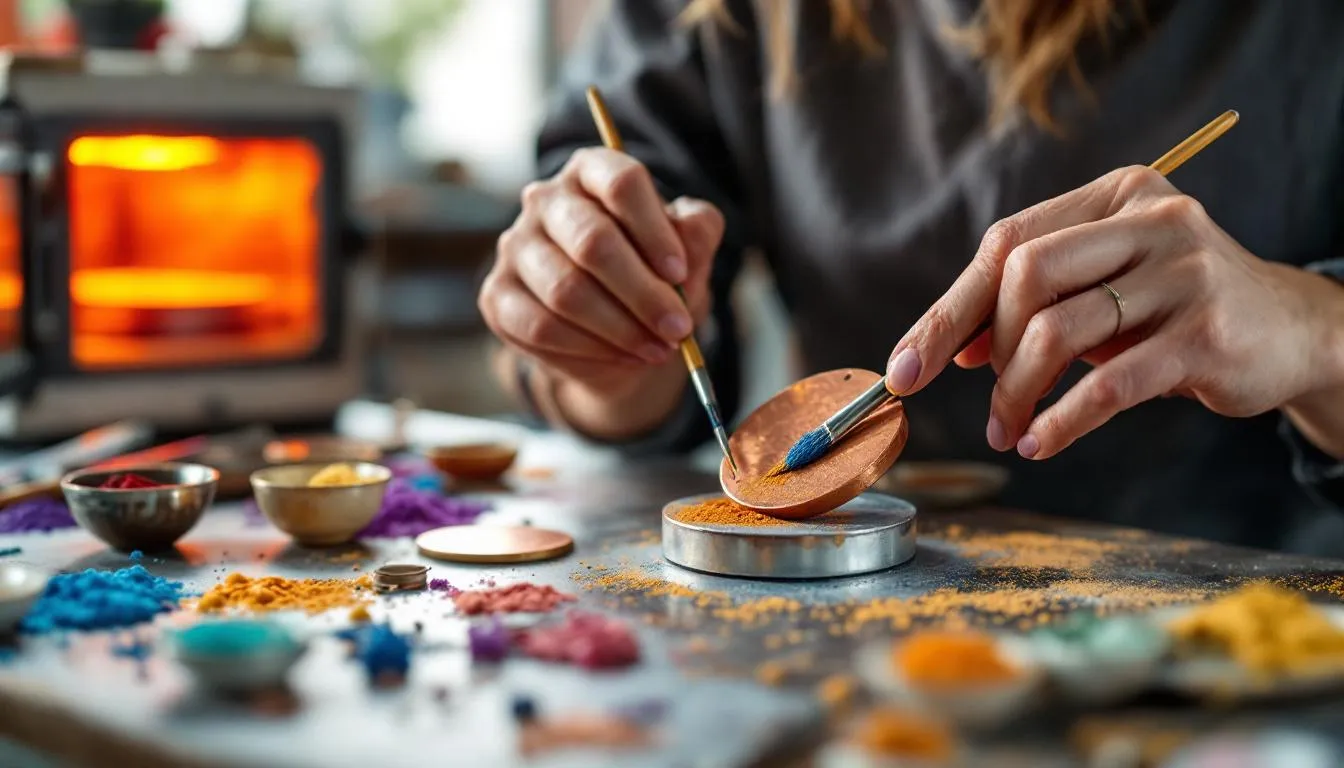
Table of Contents
What Is Enameling?
Enameling is the art and craft of fusing powdered glass to a metal surface at high temperatures, creating a smooth, glossy, brilliantly colored coating that is remarkably durable. The process produces some of the most vivid and permanent colors available to artists — enameled objects from 1500 BC retain their color today, virtually unchanged. Jewelry, decorative objects, watch dials, architectural panels, and everyday items (your kitchen stove, your bathtub) all use enamel.
How It Works
The basic process is simple in concept. Enamel is ground glass — silica mixed with metal oxides that produce specific colors (cobalt for blue, chromium for green, gold for red). The glass is ground to a fine powder (roughly the consistency of granulated sugar), applied to a clean metal surface, and heated in a kiln until it melts and bonds to the metal.
The firing happens at 1,400-1,500°F (760-815°C) — hot enough to melt glass but not hot enough to melt the metal base. Through the kiln’s viewport, you watch the enamel go through visible stages: rough and grainy, then orange-peely, then glossy-smooth. That last transition — when the surface suddenly goes liquid and glassy — happens in seconds, and pulling the piece at exactly the right moment is critical.
The bond between fused glass and metal is both chemical and mechanical — the glass fills microscopic pores in the metal surface and contracts slightly as it cools, gripping the metal. A properly enameled surface is harder than most metals, resistant to corrosion, unaffected by UV light, and effectively permanent. This durability explains why enameling has been used to preserve color for millennia.
Ancient Craft
The oldest known enameled objects are gold rings from Mycenaean Greece, dated to around 1500 BC. Egyptian, Celtic, and Byzantine craftspeople refined enameling techniques over subsequent centuries. Byzantine cloisonné enamel icons from the 10th-12th centuries are among the most treasured objects in museum collections worldwide.
The medieval period produced extraordinary enameled reliquaries, crosses, and decorative objects. Limoges, France, became the European center of enamel production — “Limoges enamel” remains a recognized quality marker. Chinese cloisonné (called jingtailan) flourished during the Ming Dynasty (1368-1644), producing the ornate vessels and decorative objects still associated with Chinese art.
Russian Fabergé eggs (made between 1885-1917 for the Russian imperial family) represent enameling at its most extravagant — guilloché enamel over engine-turned metal patterns, achieving a luminous depth of color that photographs can’t fully capture.
The Techniques
Cloisonné (“partitioned” in French) is the most recognized technique. Thin metal wires (cloisons) are bent into shapes and soldered to the base metal, creating cells. Each cell is filled with enamel powder in the desired color and fired. The wires remain visible as outlines separating the colors — think of stained glass windows, but on metal.
Champlevé (“raised field”) carves or etches recesses into the metal surface, which are filled with enamel and fired. The un-etched metal remains visible as raised lines between enameled areas. It’s the reverse of cloisonné — instead of adding dividers, you remove metal to create spaces for color.
Plique-à-jour (“open to the light”) is enamel without a backing — transparent enamel fills cells with no metal behind them, creating a stained-glass effect. Light shines through the enamel, producing extraordinary luminosity. It’s the most technically demanding form — without a backing, the enamel must support itself, and any crack during cooling destroys the piece.
Sgraffito applies a layer of enamel, fires it, applies a contrasting layer on top, then scratches through the upper layer to reveal the color beneath — like drawing through paint.
Painting enamel (Limoges technique) uses finely ground enamels mixed with oil to paint detailed images directly on a metal surface, firing each layer separately. Multiple firings (sometimes 10-20) build up layers of color and detail. It’s the closest enameling technique to traditional painting.
Modern Enameling
Contemporary enamel artists push the medium in directions that would surprise historical practitioners. Large-scale architectural enamel panels survive outdoor exposure for decades without fading. Enamel jewelry ranges from minimalist geometric designs to complex figurative miniatures. Mixed-media artists combine enamel with photography, printmaking, and digital processes.
The studio enameling community is active and accessible. Organizations like the Enamelist Society promote the craft through exhibitions, publications, and workshops. Small kilns suitable for home studios cost $200-$600. Starter kits with enamel powders, copper blanks, and basic tools run $50-$100. Community studios and art centers increasingly offer enameling classes.
Torch-fired enamel — using a handheld torch instead of a kiln — has lowered the barrier further. Small pieces (pendants, earrings, small components) can be fired with a butane or propane torch in minutes, no kiln required. The technique sacrifices some control over even heating but makes enameling possible in spaces where a kiln won’t fit.
The Appeal
Enameling attracts artists and craftspeople for specific reasons. The colors are unmatched — transparent enamels over silver or gold have a luminous, gem-like quality that no paint or glaze can replicate. The permanence is remarkable — an enameled piece will look the same in 500 years. And the process itself offers a unique combination of metalwork skills, color knowledge, and the element of fire.
There’s also the surprise factor. Enamel colors shift during firing — some dramatically. A powder that looks gray before firing might emerge from the kiln as a brilliant turquoise. Learning how colors behave through firing is experiential knowledge that can’t be fully learned from books. You have to fire, observe, fire again, and gradually build an understanding of how heat transforms glass into color.
Enameling sits at the intersection of science and art — understanding the chemistry of glass expansion, metal oxidation, and firing temperature is as important as having a good eye for color. That combination of technical knowledge and artistic vision is what makes enameling simultaneously challenging and deeply rewarding.
Frequently Asked Questions
What metals can be enameled?
Copper is the most common and beginner-friendly base metal — it's affordable, widely available, and bonds well with enamel. Fine silver and fine gold produce the most luminous results because they don't form dark oxides during firing. Steel and cast iron can be enameled (your bathtub and kitchen appliances may be enameled steel). Aluminum cannot be traditionally enameled because it melts at temperatures close to enamel's fusing point. Sterling silver is tricky because its copper content can cause firescale.
What temperature does enamel fire at?
Enamel typically fires at 1,400-1,500 degrees Fahrenheit (760-815 degrees Celsius), depending on the specific enamel formulation and the base metal. Firing time ranges from 1-4 minutes for most pieces. The enamel melts, flows, and bonds to the metal surface. Over-firing produces bubbles and color changes; under-firing results in rough, grainy surfaces that haven't fully fused. Getting the timing right requires practice and close observation through the kiln's viewing port.
Is enameling difficult to learn?
Basic enameling techniques can be learned in a weekend workshop. Sifting powdered enamel onto a copper piece and firing it in a kiln is straightforward — your first piece can be genuinely attractive. However, advanced techniques (cloisonne, plique-a-jour, champlevé, detailed painting enamel) require years of practice. Color control, multi-layer firing without cracking, and precision metalwork are skills that develop slowly. The medium rewards patience and willingness to learn from failures.
Further Reading
Cite this article
APA
WhatIs.site. (2025). What Is Enameling?. Retrieved May 27, 2026, from https://whatis.site/enameling MLA
"What Is Enameling?." WhatIs.site, July 15, 2025, https://whatis.site/enameling. Accessed May 27, 2026. Chicago
WhatIs.site. "What Is Enameling?." Last modified May 12, 2026. https://whatis.site/enameling. HTML
<a href="https://whatis.site/enameling">What Is Enameling?</a> — WhatIs.site Related Articles
What Is Jewelry Making?
Jewelry making is the craft of creating wearable ornaments from metals, gems, and other materials. Learn about techniques, tools, and getting started.
arts amp cultureWhat Is Ceramics?
Ceramics is the art and science of creating objects by shaping clay (or other earthy materials) and hardening them permanently through high-temperature.