 WhatIs.site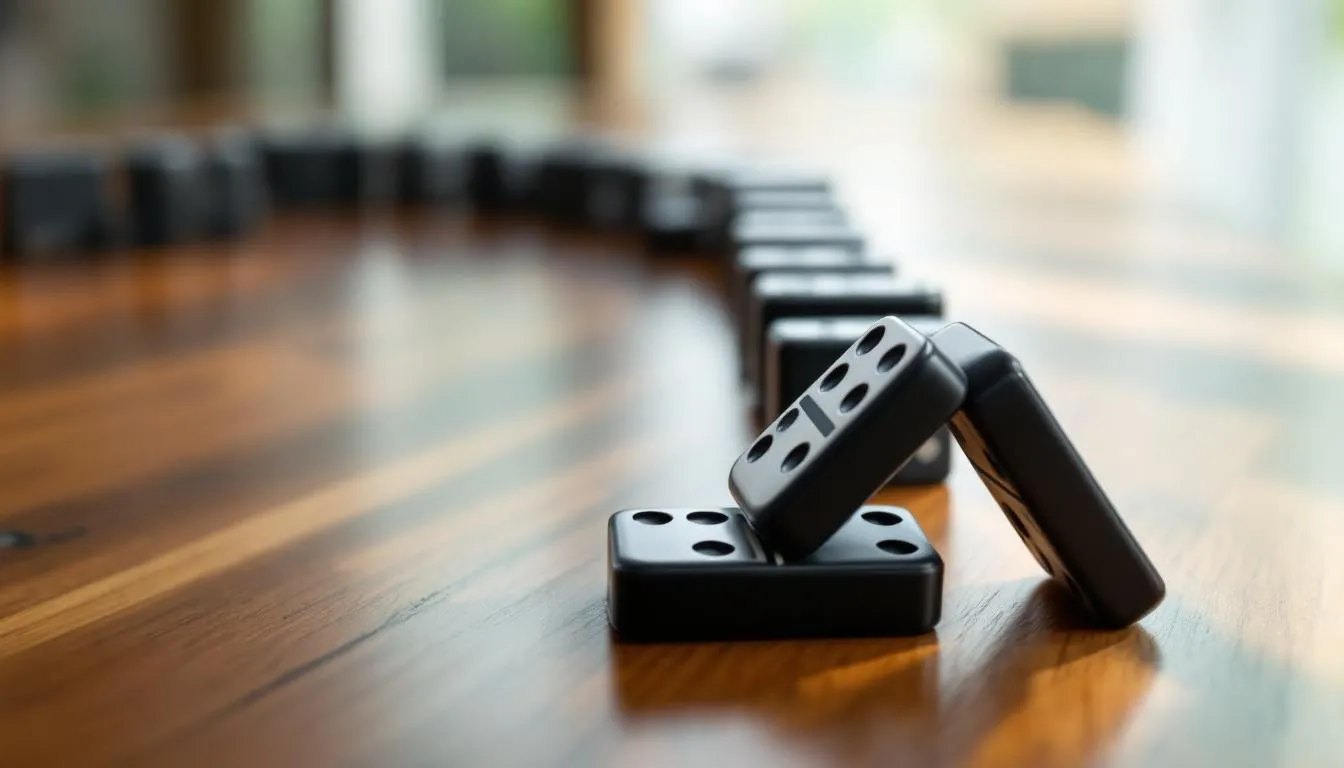
Table of Contents
What Is Dominoes?
Dominoes is a family of tile-based games played with rectangular pieces (called tiles, bones, or stones) that are divided into two halves, each marked with a number of dots (pips) or left blank. Players take turns placing tiles end-to-end, matching values, with the goal varying by variant — emptying your hand, reaching a target score, or blocking opponents. It’s one of the world’s oldest and most widespread games, played on six continents with a passion that ranges from casual to fiercely competitive.
The Tiles
A standard domino set uses “double-six” tiles — 28 pieces representing every possible combination of two values from 0 to 6. The highest tile (the double-six) has six pips on each half. The lowest (the double-blank) has none on either. Each combination appears exactly once.
Tiles are traditionally made from bone, ivory, or wood — the term “bones” for domino tiles dates to when they were literally carved from animal bone. Modern sets use plastic, resin, or composite materials. High-quality sets feature tiles with a satisfying weight and a clear, sharp clicking sound when placed. That sound is part of the game’s appeal — experienced players develop a distinctive rhythm of clicking, shuffling, and snapping tiles onto the table.
How to Play (Block Dominoes)
The simplest version — and the foundation for understanding all variants — is Block Dominoes.
Shuffle the tiles face-down. Each player draws seven tiles (for two players) or five tiles (for three to four players). The remaining tiles form the “boneyard” but aren’t used in Block (they are in Draw Dominoes).
The player with the highest double (usually double-six) plays first. Players then take turns placing one tile at either open end of the chain, matching the value on the tile to the value on the exposed end. Can’t play? You pass. First player to empty their hand wins the round. If nobody can play (the game is “blocked”), the player with the lowest pip count remaining wins.
That’s it. Five minutes to learn. But the strategy goes deeper than it looks.
Strategy
Good dominoes players track what’s been played and calculate probabilities about what opponents hold.
Counting pips is the fundamental skill. A double-six set contains a total of 168 pips across 28 tiles. Each value (0-6) appears on exactly eight tiles. If you hold three sixes and two are on the board, only three sixes remain among your opponents’ tiles. This information guides decisions about which end of the chain to play and when to hold certain tiles.
Controlling the board means playing tiles that create ends you can match while limiting opponents’ options. If you hold several fives, playing tiles that leave fives on both open ends is powerful — you can always play, and opponents often can’t.
Blocking is sometimes more valuable than scoring. Playing a tile that forces an opponent to pass gives you tempo and information. In a blocked game, every pass reveals something about what that player doesn’t have.
The double is special. Doubles are played perpendicular to the chain (purely a visual convention in most games, though some variants assign special rules). Playing a double early is often wise — they’re harder to play than regular tiles because both halves must match the same value.
Popular Variants
Draw Dominoes adds the boneyard — if you can’t play, you draw tiles until you can (or until the boneyard has only two tiles left). This reduces the strategic calculation of Block but adds more active play.
Muggins (All Fives) is the most popular scoring variant in North America. If the exposed ends of the chain total a multiple of five, the player scores that number. A layout showing 5 and 5 on the open ends scores 10 points. This adds a mathematical dimension — you’re not just matching; you’re calculating sums and trying to set up scoring plays while denying them to opponents.
Mexican Train uses a double-twelve set and allows each player to maintain a personal “train” (line of tiles) plus a communal “Mexican train” anyone can play on. It accommodates larger groups (up to eight players) and has become extremely popular as a social game.
Partnership dominoes (common in the Caribbean and Latin America) teams four players into two pairs. Partners sit across from each other and must read each other’s plays to coordinate strategy — much like Bridge in card games. In Puerto Rico, the Dominican Republic, Cuba, and Jamaica, partnership dominoes is a cultural institution, played intensely in parks, bars, and social clubs.
Cultural Significance
In the Caribbean, dominoes isn’t just a game — it’s a social ritual. Tables appear on sidewalks, in barbershops, and under trees. The tiles slam down (not gently placed — slammed, with emphasis). Trash talk is expected. Spectators gather and comment. The game functions as community gathering, social bonding, and competitive outlet simultaneously.
In China, where dominoes originated, they evolved into different games including Tien Gow and Pai Gow (which later became the basis for Pai Gow Poker played in casinos). Chinese dominoes use a 32-tile set with different pip distributions than Western sets.
The non-game use of dominoes — standing them on end in elaborate chains and toppling them — has become its own art form. Domino toppling world records involve millions of tiles arranged in complex patterns that cascade when triggered. The current record for most dominoes toppled in a chain is over 5 million.
Why Dominoes Endures
Dominoes occupies a perfect sweet spot: easy to learn, strategically interesting, social, and satisfying to play. The tiles feel good in your hands. The clicking sound is pleasant. Games are short enough to play several rounds but engaging enough to sustain an evening. And unlike many games, dominoes works equally well as a quiet two-player puzzle, a raucous four-player team battle, or a large-group party game — it just depends which variant you choose.
Frequently Asked Questions
Where did dominoes originate?
Dominoes originated in China, likely during the 12th or 13th century. Chinese dominoes were derived from cubic dice, with each tile representing one of the 21 possible results of throwing two dice. The game reached Europe (probably Italy) in the 18th century, where it was modified — European sets added blanks and eliminated duplicates of certain combinations. From Italy, dominoes spread to France, England, and eventually worldwide.
How many tiles are in a standard domino set?
A standard 'double-six' set contains 28 tiles, representing every combination of two values from 0 (blank) to 6. Larger sets exist: double-nine (55 tiles), double-twelve (91 tiles), double-fifteen (136 tiles), and double-eighteen (190 tiles). Larger sets allow more players and longer games. Most casual and competitive play uses double-six or double-nine sets.
What is the most popular domino game?
Block dominoes (also called 'straight dominoes') is the simplest and most widely known variant. Draw dominoes adds the ability to draw from a boneyard. Muggins (All Fives) — where players score when exposed ends total a multiple of five — is the most popular scoring game in North America. In Latin America and the Caribbean, partnership dominoes (four players in teams of two) is dominant and deeply culturally embedded.
Further Reading
Cite this article
APA
WhatIs.site. (2025). What Is Dominoes?. Retrieved May 27, 2026, from https://whatis.site/dominoes MLA
"What Is Dominoes?." WhatIs.site, July 15, 2025, https://whatis.site/dominoes. Accessed May 27, 2026. Chicago
WhatIs.site. "What Is Dominoes?." Last modified May 12, 2026. https://whatis.site/dominoes. HTML
<a href="https://whatis.site/dominoes">What Is Dominoes?</a> — WhatIs.site Related Articles
What Is Card Games?
Card games are games played with a deck of playing cards, encompassing thousands of variations from poker and bridge to solitaire and collectible card games.
everyday conceptsWhat Is Chess?
Chess is a two-player strategy game played on an 8x8 board with 32 pieces — 16 per side.
everyday conceptsWhat Is Board Games?
Board games are structured games played on a flat surface (a board) using pieces, cards, dice, or other components according to defined rules.
everyday conceptsWhat Is Scent Training (Dogs)?
Scent training — also called nose work or scent detection — is a structured activity where dogs learn to find and identify specific odors using.
everyday conceptsWhat Is Shakespearean Literature?
Shakespearean literature includes the plays and poems of William Shakespeare, the most influential writer in the English language. Here's why it endures.