 WhatIs.site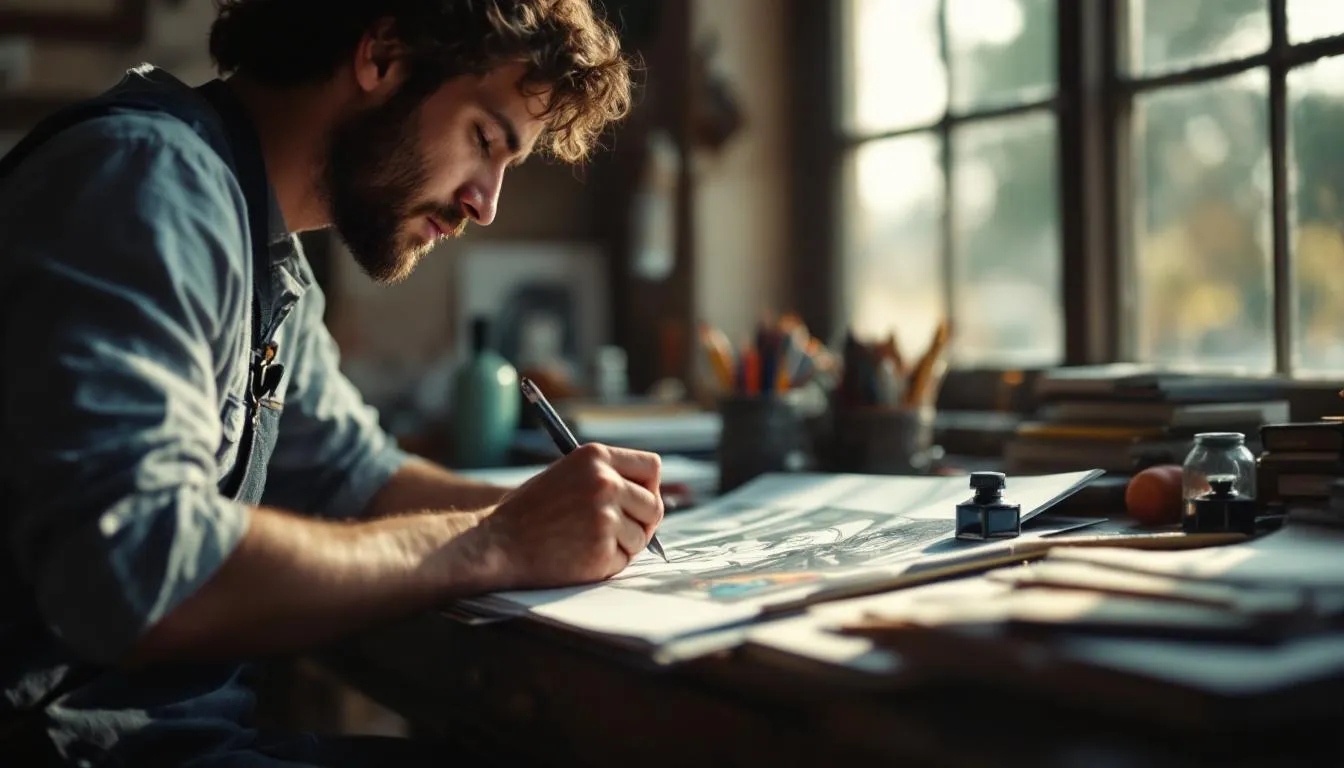
Table of Contents
What Is Comic Book Art?
Comic book art is the visual component of sequential storytelling — the drawings, inks, colors, and lettering that combine with written narrative to tell stories through panels on a page. It’s a distinct art form that blends illustration, graphic design, and cinematic composition into something uniquely its own.
Sequential Art as a Concept
Will Eisner, one of the medium’s greatest practitioners, coined the term “sequential art” to describe comics. The idea is straightforward: images arranged in a deliberate sequence to convey narrative. Each panel is a frozen moment. The space between panels — called the “gutter” — is where your brain fills in the action that connects them.
This is actually a remarkable cognitive trick. When you see a panel of someone winding up a punch, followed by a panel of someone recoiling, your mind automatically creates the impact between them. Comics don’t show everything. They show enough for your imagination to complete the story. Scott McCloud’s Understanding Comics (1993) explores this beautifully and remains the best book about how the medium actually works.
A Compressed History
Early origins (pre-1930s): Sequential visual storytelling is ancient — Egyptian tomb paintings, medieval tapestries, and Japanese picture scrolls all tell stories through images in sequence. The modern comic strip emerged in newspapers in the late 1800s, with The Yellow Kid (1895) often cited as the first recognizable comic strip.
The Golden Age (1938-1956): Superman appeared in Action Comics #1 in 1938, and the superhero genre exploded. Artists like Jack Kirby, Joe Shuster, and Bob Kane created the visual vocabulary of superhero comics — active poses, exaggerated anatomy, bold colors. The art was often rough but energetic, serving stories aimed primarily at young readers.
The Silver Age (1956-1970): Art became more polished. Kirby’s work at Marvel (with Stan Lee) created the visual template for the Fantastic Four, X-Men, and virtually the entire Marvel universe. His page compositions were cinematically ambitious — double-page spreads, dramatic foreshortening, characters bursting through panel borders.
The Modern Age (1980s-present): Frank Miller’s The Dark Knight Returns (1986) and Alan Moore and Dave Gibbons’ Watchmen (1986-87) proved comics could tell mature, complex stories with sophisticated art. Since then, the range of visual styles in comics has exploded — from the photorealistic painted art of Alex Ross to the minimalist linework of Chris Ware.
The Production Pipeline
Creating a comic book page traditionally involves several distinct roles.
The writer produces a script — either full script (describing every panel in detail) or Marvel Method (providing a plot outline and letting the artist determine the visual storytelling, with dialogue added later).
The penciler draws the pages in pencil, determining panel layouts, compositions, character poses, and backgrounds. This is often considered the most creatively demanding role, as the penciler essentially directs the visual narrative — deciding what to show, from what angle, and how much space each moment gets.
The inker goes over the pencil drawings in ink, adding weight, depth, and texture. Good inking isn’t just tracing — it’s interpretation. Different inkers bring dramatically different finishes to the same pencils. Klaus Janson inking Frank Miller looks completely different from Josef Rubinstein inking the same artist.
The colorist adds color, traditionally by hand-separating colors for printing, now almost entirely digitally. Modern digital coloring has become incredibly sophisticated — colorists like Dave Stewart and Matthew Wilson are recognized as major creative contributors, using palette and lighting to set mood and direct the reader’s eye.
The letterer places dialogue balloons, captions, and sound effects. This seems minor until it’s done badly — poor lettering can ruin page flow and readability. Good letterers are invisible in the best possible way.
Styles and Approaches
Comic art encompasses an enormous range of visual approaches.
Superhero realism — detailed anatomy, active action, dramatic lighting — dominates mainstream American comics. Artists like Jim Lee, Todd McFarlane, and more recently Pepe Larraz define this approach.
Ligne claire (clear line) is the European tradition associated with Herge’s Tintin — clean outlines, minimal hatching, flat colors. It prioritizes clarity and readability.
Manga styles from Japan use distinctive conventions — large expressive eyes, speed lines, emotional iconography (sweat drops, anger veins), and cinematic panel pacing that decompresses single moments across multiple pages. Manga outsells American comics globally by a significant margin.
Art comics and independent work explore personal, experimental visual approaches. Artists like Daniel Clowes (Ghost World), Marjane Satrapi (Persepolis), and Raina Telgemeier (Smile) use styles that serve their specific stories rather than conforming to genre conventions.
Digital vs. Traditional
The shift to digital tools has transformed comic art production. Programs like Clip Studio Paint, Procreate, and Photoshop allow artists to pencil, ink, color, and letter entirely on screen. Mistakes are undoable. Colors are unlimited. Distribution can happen instantly via webcomics and digital platforms.
But traditional tools haven’t disappeared. Many artists still prefer the tactile feel of pen on paper. Original comic art — the physical pages created by pencilers and inkers — has become a serious collectibles market, with pages by top artists selling for thousands to tens of thousands of dollars.
The hybrid approach is common: pencil traditionally, scan, and ink or color digitally. The tools are less important than the visual storytelling skills behind them.
Why Comic Art Matters
Comic book art has influenced virtually every visual medium. Storyboarding for film and television uses comic-style sequential panels. Concept art for movies and games draws heavily on comic illustration techniques. The entire visual language of superhero cinema — from camera angles to color palettes — comes directly from comic book artists who worked out these visual solutions on paper decades before Hollywood adopted them.
Museums now exhibit comic art alongside painting and sculpture. The Society of Illustrators, the Louvre, and the Smithsonian have all hosted major comic art exhibitions. The art form has earned its place — not because it’s trying to be fine art, but because it’s its own thing, done brilliantly.
Frequently Asked Questions
What is the difference between a comic book and a graphic novel?
A comic book is typically a serialized publication of 20-32 pages released monthly. A graphic novel is a longer, self-contained narrative, usually 100+ pages, published as a complete book. The art form is identical — the distinction is primarily about format and publishing model. Some graphic novels collect previously serialized comic book issues.
How are comic book pages created?
Traditional comic production involves multiple specialists. A writer creates the script. A penciler draws the pages in pencil. An inker traces over the pencils in ink to create clean, reproducible lines. A colorist adds color. A letterer adds dialogue, captions, and sound effects. Some artists handle multiple roles, and digital tools have changed the workflow significantly.
Can you make a career in comic book art?
Yes, though it is competitive. Major publishers like Marvel and DC hire freelance artists, paying page rates typically between 150 and 400 dollars per page. Independent comics, webcomics, and graphic novels offer alternative paths. Many comic artists also work in storyboarding, concept art, and illustration to supplement their income.
Further Reading
Cite this article
APA
WhatIs.site. (2025). What Is Comic Book Art?. Retrieved May 27, 2026, from https://whatis.site/comic-book-art MLA
"What Is Comic Book Art?." WhatIs.site, July 15, 2025, https://whatis.site/comic-book-art. Accessed May 27, 2026. Chicago
WhatIs.site. "What Is Comic Book Art?." Last modified May 12, 2026. https://whatis.site/comic-book-art. HTML
<a href="https://whatis.site/comic-book-art">What Is Comic Book Art?</a> — WhatIs.site Related Articles
What Is Cartooning?
Cartooning is the art of creating cartoons — simplified, often humorous drawings used in comic strips, editorial commentary, animation, and illustration.
arts amp cultureWhat Is Illustration?
Illustration is visual art created to explain, decorate, or tell stories alongside text. Learn about styles, careers, and the shift from print to digital.
arts amp cultureWhat Is Graphic Design?
Graphic design uses typography, imagery, and layout to communicate ideas visually. Learn about design principles, tools, career paths, and the field today.
arts amp cultureWhat Is Animation?
Animation is the art of creating the illusion of movement by displaying a sequence of images in rapid succession. Explore its types, history, and techniques.
arts amp cultureWhat Is Sushi Making?
Sushi making is the Japanese culinary art of preparing vinegared rice with fish and other ingredients. Learn the types, techniques, and traditions behind it.