 WhatIs.site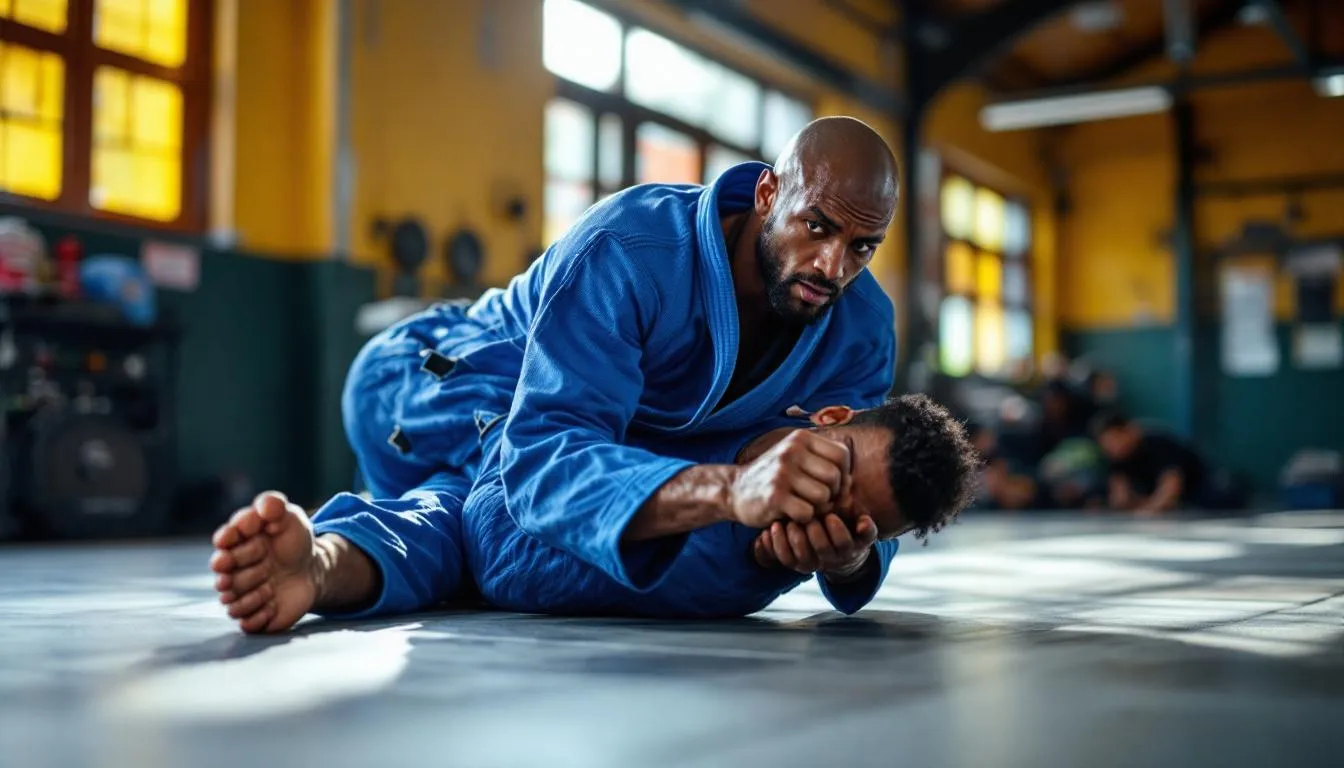
Table of Contents
What Is Brazilian Jiu-Jitsu?
Brazilian Jiu-Jitsu (BJJ) is a grappling-based martial art that specializes in ground fighting and submission holds. Its core principle — that a smaller, weaker person can defeat a larger, stronger opponent using proper technique, use, and positioning — was dramatically proven in the early UFC tournaments and has made BJJ the fastest-growing martial art in the world.
The Gracie Story
BJJ’s history begins in Japan, passes through South America, and explodes worldwide through mixed martial arts.
In the early 1900s, Japanese judoka and jiu-jitsu practitioner Mitsuyo Maeda emigrated to Brazil. He taught his art to Carlos Gracie, who along with his brothers — particularly the smaller Helio Gracie — adapted the techniques to emphasize ground fighting over standing throws. Helio, who was physically slight, refined techniques that worked even when facing larger opponents, developing what became Brazilian Jiu-Jitsu.
The Gracie family issued open challenges (“the Gracie Challenge”) to practitioners of other martial arts for decades, compiling an impressive record. But the art gained global recognition when Royce Gracie — chosen specifically because he was not the largest or strongest family member — won the first three UFC tournaments (1993-1994), submitting opponents who outweighed him by 50+ pounds.
Those early UFCs demonstrated something that martial arts traditionalists didn’t want to hear: most fights go to the ground, and the fighter who knows what to do there usually wins. BJJ enrollment exploded worldwide.
How BJJ Works
Positional Hierarchy
BJJ organizes ground fighting into a hierarchy of positions, from most dominant to least:
- Back control (behind your opponent, legs hooked) — Most dominant position
- Mount (sitting on opponent’s chest) — Very dominant
- Side control (chest-to-chest, perpendicular) — Strong control
- Half guard (partially between opponent’s legs) — Neutral
- Guard (on your back with opponent between your legs) — Defensive but active
- Bottom mount/bottom side control — Worst positions
The strategic goal: advance to a more dominant position, then apply a submission. The defensive goal: escape bad positions and reverse the hierarchy.
Submissions
Submissions are techniques that threaten joint damage or strangulation, forcing the opponent to “tap out” (signal surrender). Main categories:
Chokes — Restricting blood flow to the brain through compression of the carotid arteries. The rear naked choke, triangle choke, and guillotine are among the most common. A properly applied choke renders someone unconscious in 8-12 seconds.
Joint locks — Hyperextending or rotating joints beyond their normal range. Armbars, kimuras, and heel hooks target the elbow, shoulder, and knee respectively. These techniques can cause serious injury if the opponent doesn’t tap quickly enough.
The Guard
BJJ’s distinctive contribution to martial arts is the guard — a position where the person on their back controls the person on top using their legs. In most martial arts, being on your back is considered a losing position. In BJJ, a skilled guard player can sweep (reverse position), submit, or stall an opponent from the bottom. This insight revolutionized ground fighting.
Training Culture
A typical BJJ class includes warm-ups, technique instruction (the instructor demonstrates a sequence; students drill with partners), and live rolling (sparring at varying intensities). Rolling is where learning actually happens — techniques that work in drilling must function against a resisting opponent.
The culture is generally welcoming to beginners, though the learning curve is steep. Your first months of BJJ involve a lot of being submitted, pinned, and confused. This ego-checking process — being physically controlled by people smaller than you — is part of the art’s character-building reputation.
The belt system (white through black) reflects the long development timeline. A BJJ blue belt (typically earned after 1-2 years) represents more training time than a black belt in many other martial arts. The culture treats rank seriously — sandbagging (competing below your actual skill level) is frowned upon.
BJJ and MMA
BJJ is a mandatory skill in modern mixed martial arts. The UFC’s early years proved that fighters without ground skills were vulnerable to submission. Today, every serious MMA fighter trains BJJ extensively, even if their primary discipline is striking.
The relationship runs both ways — MMA has influenced BJJ training. Competition BJJ now includes more wrestling-based takedowns, more leg lock attacks, and more athleticism than the traditional Gracie self-defense curriculum.
Health and Fitness Benefits
BJJ provides a full-body workout that burns 500-1,000 calories per hour depending on intensity. It develops cardiovascular endurance, functional strength (particularly grip, core, and hip strength), flexibility, and body awareness.
The physical demands) are significant. BJJ stresses joints — particularly the neck, shoulders, elbows, and knees — and injuries are common with years of training. Cauliflower ear (permanent ear deformation from repeated friction and impact) is a recognizable badge among long-term practitioners.
Mental health benefits are widely reported. The intense focus required during rolling — where a momentary lapse in attention means getting submitted — functions as forced meditation. Many practitioners describe BJJ as the only time their mind is completely quiet, because the demands of the moment overwhelm everything else.
The Community
BJJ has created one of the strongest martial arts communities in the world. The sport transcends typical demographic boundaries — professors, plumbers, lawyers, and teenagers all train together, differentiated only by belt color. The vulnerability of the training (being physically controlled and submitted regularly) creates bonds that are difficult to replicate in less intimate activities.
The global community now includes an estimated 4 million practitioners across over 10,000 academies worldwide. Competition ranges from local tournaments to IBJJF World Championships, the ADCC Submission Wrestling World Championship, and professional superfight organizations.
Whether you’re training for self-defense, competition, fitness, or simply because physical problem-solving against a resisting human is the most interesting puzzle you’ve ever encountered, BJJ offers depth that takes a lifetime to explore. The art is honest — every claim about what works and what doesn’t gets tested on the mat, every day.
Frequently Asked Questions
How long does it take to get a black belt in BJJ?
Most BJJ practitioners take 8 to 15 years of consistent training to earn a black belt, making it one of the longest paths to black belt in any martial art. Belt progression goes: white, blue (typically 1-2 years), purple (3-5 years), brown (5-8 years), black (8-15 years). Each belt requires demonstrated proficiency through training and competition.
Is BJJ effective for self-defense?
Yes, BJJ is widely considered one of the most effective martial arts for real-world self-defense, particularly in one-on-one confrontations. Most street fights end up on the ground, where BJJ's specialization gives practitioners a significant advantage. However, BJJ's focus on one-on-one ground fighting is less effective against multiple attackers or in situations where going to the ground is dangerous.
What is the difference between gi and no-gi BJJ?
Gi BJJ is practiced in a traditional cotton uniform (gi or kimono) that fighters can grip for throws, sweeps, and submissions. No-gi BJJ uses rash guards and shorts, eliminating gripping options and creating faster, more athletic scrambles. Both have their own competitive circuits. MMA fighters often train no-gi; traditional practitioners may prefer gi training.
Further Reading
Cite this article
APA
WhatIs.site. (2025). What Is Brazilian Jiu-Jitsu?. Retrieved May 27, 2026, from https://whatis.site/brazilian-jiu-jitsu MLA
"What Is Brazilian Jiu-Jitsu?." WhatIs.site, July 15, 2025, https://whatis.site/brazilian-jiu-jitsu. Accessed May 27, 2026. Chicago
WhatIs.site. "What Is Brazilian Jiu-Jitsu?." Last modified May 12, 2026. https://whatis.site/brazilian-jiu-jitsu. HTML
<a href="https://whatis.site/brazilian-jiu-jitsu">What Is Brazilian Jiu-Jitsu?</a> — WhatIs.site Related Articles
What Is Self-Defense?
Self-defense is the act of protecting yourself or others from physical harm through awareness, avoidance, de-escalation, and — when necessary.
health amp wellnessWhat Is Fitness?
Fitness is your body's ability to perform physical tasks effectively. It covers cardiovascular endurance, strength, flexibility, and body composition.
sportsWhat Is Aikido?
Aikido is a Japanese martial art focused on redirecting an attacker's energy rather than meeting force with force. Learn its history, techniques, and.
scienceWhat Is Anatomy?
Anatomy is the study of body structure in living organisms. Learn about gross and microscopic anatomy, organ systems, history, and why it matters in medicine.
scienceWhat Is Sports Science?
Sports science applies biology, physics, and psychology to improve athletic performance, prevent injuries, and optimize training. Here's how it works.