 WhatIs.site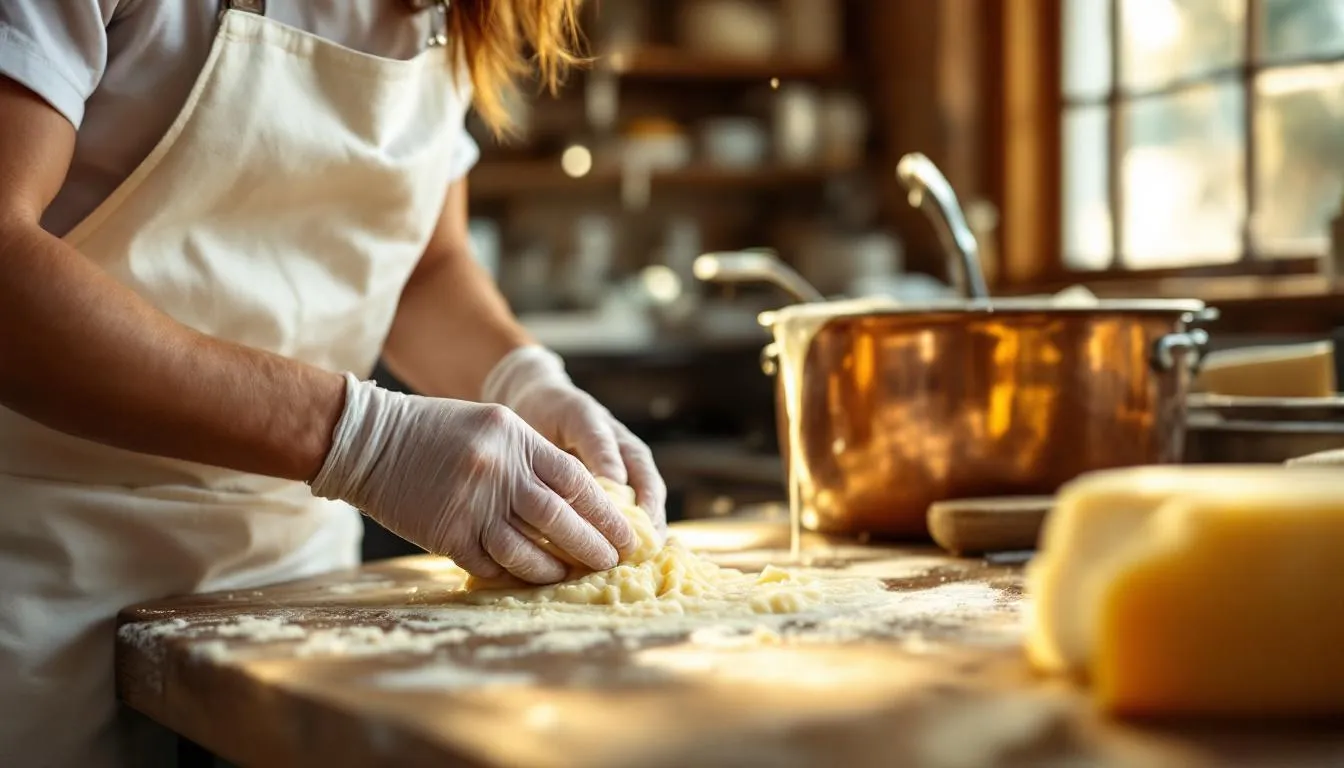
Table of Contents
What Is Cheese Making?
Cheese making is the process of converting milk into cheese — concentrating milk’s proteins and fats into a solid form through acidification, enzyme-driven coagulation, and (usually) aging. Humanity has been making cheese for at least 7,000 years, producing over 1,800 named varieties worldwide. It’s controlled spoilage, essentially — persuading milk to go bad in exactly the right way.
Milk’s Greatest Transformation
The basic idea behind cheese is elegant: milk contains protein (casein), fat, water, sugar (lactose), and minerals. Cheese making separates the protein and fat from the water, concentrates them, and then — through aging — transforms them into something far more complex than raw milk could ever be.
Ten pounds of milk produces roughly one pound of cheese. All that concentration means cheese packs enormous flavor and nutrition into a small package. Parmigiano-Reggiano contains about 30% protein and 30% fat by weight, plus concentrated calcium and B vitamins. It’s a survival food that our ancestors figured out long before they understood why it worked.
The oldest direct evidence of cheese making comes from pottery fragments in Poland dating to about 5500 BCE — residues show milk fats were processed through perforated ceramic vessels (essentially cheese strainers). Cheese making likely began even earlier, probably when someone stored milk in a bag made from an animal stomach, and the residual stomach enzymes curdled the milk. Happy accident.
The Basic Process
Step 1: Acidification
Starter cultures (specific strains of bacteria) are added to warm milk. These bacteria consume lactose and produce lactic acid, gradually lowering the milk’s pH. The type of starter culture influences the cheese’s final flavor — mesophilic cultures (working at moderate temperatures) for cheddar and gouda, thermophilic cultures (higher temperatures) for Swiss and mozzarella.
Step 2: Coagulation
Rennet — an enzyme mixture traditionally from calf stomachs, now more commonly produced through fermentation — is added. Rennet causes casein proteins to link together, forming a gel-like mass called curd. The milk goes from liquid to something resembling tofu in about 30-45 minutes.
Step 3: Cutting and Cooking the Curd
The curd is cut into pieces (smaller pieces for harder cheeses, larger for softer ones). Cutting releases whey — the watery liquid that separates from the curds. The curds are then gently heated, which expels more whey and firms the curds. Higher cooking temperatures produce drier, harder cheese.
Step 4: Draining and Pressing
Whey is drained off, and curds are pressed into molds. Pressing force determines final texture — light pressing for semi-soft cheeses, heavy pressing for hard cheeses like cheddar. During pressing, remaining whey is expelled and the curds knit together into a solid mass.
Step 5: Salting
Salt is added by mixing into the curds (cheddar-style), rubbing onto the surface of formed cheese, or soaking the cheese in brine (a salt-water bath). Salt serves triple duty: flavoring, preservation (inhibiting unwanted bacteria), and controlling the activity of the cheese’s starter cultures and enzymes.
Step 6: Aging (Affinage)
This is where the magic happens. Fresh curds taste mild and rubbery. Aging — in controlled environments with specific temperature and humidity — transforms them through enzymatic breakdown of proteins and fats, producing the complex flavors and textures that distinguish great cheese.
Aging rooms (caves, cellars, or climate-controlled rooms) typically maintain 50-55°F and 80-95% humidity. Some cheeses develop natural rinds; others are waxed, cloth-wrapped, or washed with brine or alcohol during aging. Washed-rind cheeses (like Époisses and Taleggio) get their pungent aroma from bacteria encouraged by regular washing — the same bacteria that cause foot odor, which explains the smell.
Major Cheese Families
Fresh cheeses — No aging. Ricotta, mozzarella, chèvre, cream cheese, cottage cheese. Mild, high moisture, perishable. Mozzarella is fascinating to make — stretched curd cheese (pasta filata) where hot curds are kneaded and stretched in hot water until smooth and elastic.
Soft-ripened — Aged briefly with surface molds. Brie and Camembert develop a white Penicillium candidum rind that produces enzymes ripening the cheese from outside in. A perfectly ripe Camembert is liquid just beneath the rind and chalky at the center.
Semi-hard — Cheddar, gouda, Gruyère, Manchego. Pressed, aged months to years. This is the largest cheese category and the workhorse of cooking. Cheddar alone accounts for roughly 30% of U.S. cheese consumption.
Hard/aged — Parmigiano-Reggiano, aged gouda, Pecorino Romano. Very low moisture, intensely flavored, grated as often as sliced. Parmigiano-Reggiano production is strictly regulated — it can only be made in specific Italian provinces, from specific cows, using specific methods, and aged a minimum of 12 months.
Blue cheeses — Inoculated with Penicillium roqueforti or P. glaucum, which grow through the interior creating blue-green veins and distinctive sharp, tangy flavor. Roquefort, Gorgonzola, Stilton. The mold is introduced by piercing the cheese with needles, allowing air to reach the interior.
Artisan and Farmstead Cheese
The U.S. artisan cheese movement has exploded since the early 2000s. The American Cheese Society’s annual competition received over 1,900 entries from 260 companies in recent years. Small producers making cheese from their own herds’ milk (farmstead cheese) now compete with — and often beat — European cheeses that have centuries of tradition behind them.
The economics are challenging. Artisan cheese requires quality milk ($20-30 per hundredweight), aging space (capital-intensive and slow to generate revenue), and significant labor. A wheel of cheese aged for two years ties up capital and space for two years before generating a single dollar of revenue. But the premium prices ($15-$40+ per pound for artisan cheese vs. $5-8 for commodity cheese) can make the math work.
Cheese making connects you to one of humanity’s oldest food technologies — the same fundamental process that Neolithic farmers used to preserve surplus milk is what produces the wheel of aged cheddar in your local cheese shop. The bacteria have been refined, the temperature control improved, and the science understood. But you’re still persuading milk to transform itself, one controlled spoilage at a time.
Frequently Asked Questions
How long does it take to make cheese?
Fresh cheeses (ricotta, mozzarella, chèvre) can be made in hours. Semi-hard cheeses (cheddar, gouda) require days to weeks of initial production plus months of aging — typically 2-12 months. Hard aged cheeses (Parmigiano-Reggiano, aged cheddar) require 1-7+ years of aging. A wheel of Parmigiano-Reggiano spends a minimum of 12 months aging, with premium versions aged 24-36 months.
What is rennet?
Rennet is a complex of enzymes (primarily chymosin) that coagulates milk, separating it into solid curds and liquid whey. Traditional rennet comes from the stomach lining of young ruminant animals (calves, kids, lambs). Vegetable rennet (from plants like thistle), microbial rennet (from fungi), and genetically engineered rennet (fermentation-produced chymosin, used in ~90% of U.S. cheese) are common alternatives.
Can you make cheese at home?
Yes. Ricotta requires only milk, acid (vinegar or lemon juice), and heat — it's a 30-minute project. Fresh mozzarella is a satisfying afternoon project. Hard cheeses require more equipment (cheese molds, a press, aging space with controlled temperature and humidity) and patience (months of aging), but the process is well-documented and achievable with modest investment.
Further Reading
Cite this article
APA
WhatIs.site. (2025). What Is Cheese Making?. Retrieved May 27, 2026, from https://whatis.site/cheese-making MLA
"What Is Cheese Making?." WhatIs.site, July 15, 2025, https://whatis.site/cheese-making. Accessed May 27, 2026. Chicago
WhatIs.site. "What Is Cheese Making?." Last modified May 12, 2026. https://whatis.site/cheese-making. HTML
<a href="https://whatis.site/cheese-making">What Is Cheese Making?</a> — WhatIs.site Related Articles
What Is Charcuterie?
Charcuterie is the craft of preparing and preserving meats — including curing, smoking, and fermenting — to create products like salami, prosciutto, and pâté.
everyday conceptsWhat Is Beer Brewing?
Beer brewing is the process of converting grain starches — usually from malted barley — into a fermented alcoholic beverage through mashing, boiling.
everyday conceptsWhat Is Candy Making?
Candy making is the art of creating confections by heating sugar to specific temperatures and combining it with flavors, colors, and other ingredients.
everyday conceptsWhat Is Baking?
Baking is the method of cooking food by surrounding it with dry heat in an enclosed space, typically an oven.
scienceWhat Is Food Science?
Food science is the applied discipline that uses biology, chemistry, and engineering to study the nature of food, the causes of its deterioration.